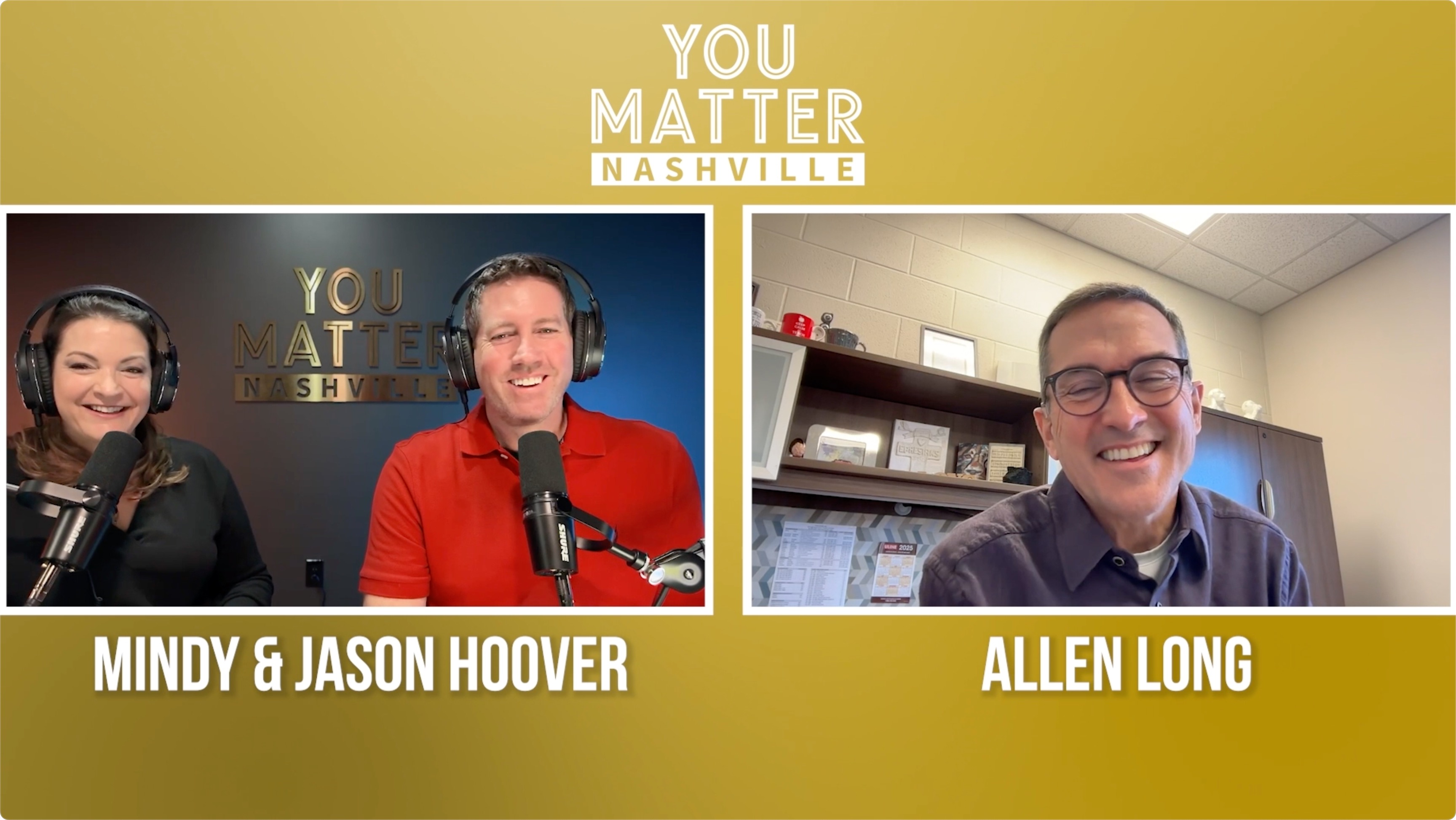
Graham Honeycutt, From Tucker's House Dad to Its Leader
Tucker's House is a Franklin, Tennessee nonprofit that modifies homes for families of children and young adults with disabilities, from ramps and widened doorways to accessible bathrooms and lifts, with each design shaped by a therapist's assessment to last the child's lifetime. Families who meet its financial qualifications pay nothing. Executive Director Graham Honeycutt first came to it as a dad. Learn more at tuckershouse.org.
Listen to the episode
Jump to a moment
- 00:00, Introduction to You Matter Nashville
- 00:36, Graham Honeycutt's Journey with Tucker's House
- 03:00, Mikayla's Story and the Need for Accessibility
- 06:35, The Importance of Independence for Children with Disabilities
- 10:22, Transitioning from Grief to Community Involvement
- 17:01, The Founding of Tucker's House
- 19:24, Unique Approach to Home Modifications
- 21:10, Funding and Community Support for Tucker's House
- 24:08, Transforming Houses into Homes
- 25:55, The Importance of Human Connection
- 26:51, The Exhaustion of Caregiving
- 28:31, Understanding Family Needs
- 29:57, The Cost of Caregiving
- 32:26, Financial Support for Families
- 34:56, Average Costs of Home Modifications
- 36:23, Lessons in Support and Community
- 39:34, How to Support Tucker's House
- 41:31, Understanding the Struggles of Families
- 43:57, Opportunities for Involvement
This episode includes a father talking about the death of his young daughter.
What if the hardest room in your house was the one where your child needed help the most? Graham Honeycutt knows that question from the inside. Before he led Tucker's House, he was a dad in Middle Tennessee who was the only person at home strong enough to lift his daughter, Mikayla. On this episode of You Matter Nashville, Jason and Mindy Hoover talk with Graham about the family side of accessibility, the organization that showed up for his, and why a safe home is about more than a ramp.
How did Graham go from being helped to leading the work?
Graham found Tucker's House the way many families do, through a therapist. Mikayla was born with Dandy-Walker syndrome, and by the time she was four or five, with toddler twins in the house as well, Graham was the only one who could lift her, bathe her and change her. His wife, Heather, is five feet tall, and the manual transfers were getting harder and less safe. A physical therapist at Mikayla's daycare pointed them toward help.
Tucker's House assessed the home and made temporary changes, and the family was planning an accessible bathroom when Mikayla passed away in 2018. Graham stayed involved. He had a golf background, so he helped run the charity golf tournament. About six and a half years ago, founder Sunny Rosanbalm told him she was ready to retire and hand off the reins, and he was the one who came to mind.
"Once a Tucker's House family, always a Tucker's House family."
He talks about grief honestly. When you lose a child you were caring for full time, all the energy that went into her care has to go somewhere, and for months the reminders kept coming: time for her medicine, time to feed her. Leading an organization that already existed, rather than starting a foundation of his own, felt like the natural way to honor her and stay part of the community that had carried his family.
Why does independence matter as much as safety?
Most people picture a ramp and a wider doorway, Graham says, but the goal goes further. When a child can use a ceiling track lift to get out of bed and into a wheelchair, or reach a sink to brush their own teeth and wash their hands, a family's daily life changes, and so does the child's confidence.
He points to Addie, a young woman whose painting hangs behind him. Before her modifications, the only time she left her house was in an ambulance. Now in her twenties, she gets out into her neighborhood, walks her service dog with her power wheelchair, and has a life beyond her bedroom. Her story is part of House to Home, the video series Tucker's House produces.
For Mikayla, who was fully dependent on her parents, the changes meant safety and something else: access to the rest of the house, and to her siblings.
How did Tucker's House get started?
Tucker's House is named for founder Sunny Rosanbalm's grandson, Tucker, who had seizures just days after he was born that left him with disabilities. As he grew, his parents struggled to care for him in a home that wasn't built for him. Sunny, who has an architectural design background and whose husband is a general contractor, started calling around for help and couldn't find anyone. So in 2009 she started it herself.
Tucker is in his twenties now, and Sunny still comes out to speak at the organization's family dinner fundraiser.
Why pair a therapist with a designer?
Every project starts with a therapy assessment. Graham credits an early partnership between Sunny and a physical therapist trained in home modifications, who asked what it would look like to design with someone who knew not only a child's diagnosis but also their prognosis. The answer is a bathroom built for the life of the child, not one that has to be ripped out in five years when needs change.
That planning is most of the job. Assessments, design reviews, and choosing materials that fit a family's medical needs and allergies take longer than the build itself, which the team usually finishes in two or three weeks once construction starts. Specialty contractors who understand accessible construction make sure details like a new shower drain properly.
What does a project cost, and who pays for it?
Qualifying families pay nothing. Families have to meet financial qualifications, and if they do, Tucker's House covers the full cost of the modifications. Graham says a small project runs a few thousand dollars, a medium one close to ten thousand, and a large one twenty-five to thirty thousand, and those figures already reflect partners who discount and donate their work.
The money comes mostly from private grants and foundations, contractors who donate skilled labor, individuals and companies, an annual family dinner, and House to Home. Graham says Tucker's House takes on about ten to twelve family projects a year, in scopes that range from a couple of widened doorways and grab bars to a full bathroom.
The research behind the need is stark. Tucker's House found that a typical family it serves makes about five thousand manual transfers a year, lifting a child in and out of beds, chairs and tubs. Graham calls those five thousand opportunities for injury.
What do these families wish the rest of us knew?
When families call, Graham says, the request underneath almost every one is the same: help our house feel like a home again. For many of them, home has become another place of struggle rather than rest. He describes a single mom who couldn't lift her son, who weighs twice as much as she does, and gave him a bath by dragging him across the floor on a towel and sprinkling water over the side.
That's why he talks about helping families feel seen, not only about new bathrooms. They're regular people carrying more than most, he says, with a lot of love in their homes, and they want connection, not to be defined by the struggle.
How can Middle Tennessee help right now?
Graham asked for three things. Give, since donations let Tucker's House serve more families. If you know a family in Davidson County raising a child with disabilities, have them reach out right away, because at the time of this September 2026 recording Tucker's House had a grant for Davidson County families that was on a time clock. And if you work in architecture, engineering or construction, your donated skilled labor is needed, and there's a form on the Tucker's House website to refer a contractor.
General volunteer roles are limited because the work is skilled, but anyone can follow Tucker's House, watch House to Home and share it. Graham says a lot of people in the community still don't know the organization exists. Jason's answer to that was simple: word of mouth.
Episode Resources
- Official site: tuckershouse.org
- Donate: tuckershouse.org/donate
- Refer a family: tuckershouse.org/refer
- Refer a contractor: tuckershouse.org/refer-a-contractor
- House to Home video series: tuckershouse.org/house-to-home
- Events: tuckershouse.org/events
- Email: info@tuckershouse.org
Ways to Help
Give to Tucker's House, which covers the full cost of home modifications for families who qualify. If you know a family in Davidson County raising a child with disabilities, Graham asked that they reach out now, since a Davidson County grant was on a time clock as of September 2026. Contractors, architects and others in architecture, engineering and construction can donate skilled labor, and anyone can follow Tucker's House, watch House to Home and share it.
Guest Information
Graham Honeycutt
Graham Honeycutt is the executive director of Tucker's House, the Franklin nonprofit that makes homes safe and accessible for families of children and young adults with disabilities. He came to it first as a dad. Tucker's House helped his family care for his oldest daughter, Mikayla, who was born with Dandy-Walker syndrome and passed away in 2018. Graham stayed close, helping run the charity golf tournament, and in 2020 founder Sunny Rosanbalm asked him to take over. He brings nonprofit experience in operations, marketing and fundraising, and he wears a band with Mikayla's name to every project.
About the Organization
Tucker's House
Tucker's House is a Franklin, Tennessee nonprofit that provides home modifications for families of children and young adults with disabilities. Founded in 2009 by Sunny Rosanbalm, an architectural designer, and named for her grandson Tucker, it builds ramps, accessible bathrooms, lifts and other changes that make a home safe and help a child live more independently. A therapist's assessment shapes each design so it lasts the child's lifetime. Families who meet its financial qualifications pay nothing for the work, and it serves families across Middle Tennessee.
Visit the organization websiteKnow Someone Making a Difference?
Nominate a Middle Tennessee changemaker for a future You Matter Nashville episode.
Nominate a GuestTucker's House, tuckershouse.org (official site, checked 2026-09-28). Our Story, tuckershouse.org/story (founded 2009 by Sunny Rosanbalm, vision statement, checked 2026-09-28). Our Team, tuckershouse.org/staff (Graham Honeycutt, Executive Director, checked 2026-09-28). House to Home, tuckershouse.org/house-to-home (Season 3 featuring Addie, checked 2026-09-28).
Full transcript
Read
Jason: Welcome to You Matter Nashville, where we celebrate the people and stories that make our community so special. We believe that everyone has a story to tell, and more importantly, everyone here matters.
Mindy: We're your hosts, Jason and Mindy Hoover, and we're passionate about shining a light on individuals who are making a real impact right here in Middle Tennessee. This is about community, connection, and the incredible people who are making a difference.
Jason: Let's dive in as we uncover powerful stories and meet remarkable people whose journeys will inspire us all, right here on You Matter Nashville.
Jason: Hey friends, welcome back to You Matter Nashville. I'm Jason Hoover, along with my beautiful wife, Mindy. And thank you so much for spending time with us today. We've got a very special guest for you. His name is Graham Honeycutt. He's with Tucker's House, and he is a man that came to this work first as a dad and now leads the organization that showed up for his family. Graham, great to have you.
Graham: Yeah, great to be here. Thanks so much for having me on.
Jason: Absolutely. Well, as always, I like to share with our listeners a little bit about who we have on the show today. Graham Honeycutt is the executive director of Tucker's House, which is a Franklin nonprofit that makes homes safer and more accessible for families of children and young adults with disabilities. He found Tucker's House the way a lot of families do, as a dad who needed help. They built a ramp and an accessible bed for his daughter, Mikayla. And after Mikayla passed away in 2018, Graham stayed close to this organization. When founder Sunny Rosanbalm was ready to hand off the reins, Graham was the one who came to mind, and he stepped in as executive director in 2020. He brings years of nonprofit experience in operations, marketing, and fundraising. And it says here that he wears a band with Mikayla's name on it so he can bring her along to every project. He and his wife Heather have four other daughters and a son. Graham, thank you again for joining us today. We are looking forward to hearing about your journey. And you've got a story to tell, so everybody, just hang tight and get your tissues ready.
Graham: Yeah, well, thank you, that was a great bio. I don't normally get such an in-depth bio. Usually it's just the cursory, like, here's where you work and this is who you are. So yeah, I really appreciate that, even the band, you know, with her name around it. I'm glad I was wearing it today.
Mindy: Right, right. Preaching it. Well, we're so glad that you're here. And yeah, I really want to hear more about the pre-story of your family and that connection before you actually came into Tucker's House to take that over. I'd love to hear that beginning, because I know we kind of get a unique story today, hearing both sides. So it's very unique today.
Graham: Yeah, so our oldest daughter, Mikayla, was born with a rare congenital brain malformation called Dandy-Walker syndrome. So basically that means she was born with excess fluid in her brain where brain matter should be. And so, you know, really early on, right at that twenty-week ultrasound, they really only gave her a one in four chance of surviving the pregnancy, and they just let us know, you know, if she did survive, she was going to have really significant special needs, most likely, when she was born. So thankfully she did survive the pregnancy, and they did surgery when she was a day old to place a shunt in her brain that would help drain that fluid into her abdomen. And you know, even though she had a lot of challenges, I just loved Mikayla. Like, I loved being with her. She was such a sweet soul.
Graham: And then, you know, we mentioned our other kids. When Mikayla was eighteen, we found out we were having twins. So you know, we went from special needs [unclear] to multiples, right back to back. But it was really around the time that the twins were starting to become toddlers, and Mikayla was four, five years old, that we were really having some difficulties in our home. I was really the only one at that point who could really lift Mikayla, bathe Mikayla, change her diaper, you know, feed her. It was just harder. My wife is, you know, five feet tall and slight, so it was just harder for her to navigate. So that was really when we started those conversations with Tucker's House of, you know, how can we make our home a place that's accessible and safe for her, where she's not in danger of us dropping her, from injury or a fall, and we're not having to lift her constantly and do all those manual transfers. So that was really the lead story. And right as we were getting ready to do a larger project for her, we started talking to Sunny Rosanbalm, our founder at the time. We started talking with Sunny about doing an accessible bathroom, but it was right around that time that she passed away. So we never really got to realize that full accessibility scope.
Graham: But I stayed in touch with Sunny. I have a golf background from before I was in this work, so I helped run their charity golf tournament, just as a way to give back and stay involved. And it was six and a half years ago that Sunny just said, hey, I'm looking to retire, I'm looking to, as you mentioned, hand off the reins, and I came to mind. And it was my honor to accept.
Mindy: That's great. And you know, a lot of people don't realize, when you talk about accessibility, they think a ramp, a handrail here and there. They don't think about what it's like to have even an adult child with disabilities and what that looks like to care for them, especially if you're a five-foot-tall parent and you don't have the leverage of somebody who's six-two who can pick somebody up and move them around. So there's a lot that goes into it. So that's really incredible that the founder has that architectural aspect. They can think about all those things that can help the families really make it easier, because this is a lifelong thing. So it's incredible.
Graham: Yeah, absolutely. And it's not just, you know, again, like you said, most people think ramp, widen the doorway, and you're set to go. But there are so many other challenges, and something that we really focus on too is if the child is able to have independence, we want to provide those opportunities for them. So, you know, they might be able to get themselves out of bed if they have a ceiling track lift, and they're able to get themselves into their chair, and then that chair is how they navigate the world. So if we're able to provide that independence to them, we will certainly try to seek those opportunities to maximize that. So even simple things, like being able to brush their teeth on their own, wash their hands. These are all things that in an inaccessible bathroom or house, children aren't able to do for themselves. They're depending on their parents or their caregivers to do it for them. So that can really shift a family's and a child's life as well, gaining that independence and confidence.
Jason: Yeah, I can only imagine how much confidence that gives them, and self-esteem.
Graham: Yes.
Jason: I'm curious. So we know it helps them [unclear]. How did that impact you?
Graham: Well, Mikayla was a case where she really was fully dependent on us. You know, she couldn't use any type of power chair or anything like that. She didn't have the ability, or the cognitive ability, to really do that. So for us, what it really did is just provide more safety and accessibility for her, and also different access to the home. I think that's the other thing, you know, when you live in a house that maybe has multiple stories, they don't have any access to their siblings if their bedrooms are upstairs, or if a family room is in a different area of the house, or you can't fit a wheelchair through a certain door to a family room, or whatever it may be. So for us, it was more about the safety, accessibility, and then having her have access to her siblings, and for her siblings to have interaction with her.
Graham: But you know, we have other cases. Actually, this painting right here is painted by one of the children we serve, and she's really an adult now. Now she's twenty-two, so at the time she was, you know, twenty when we did the modifications. But she is now able to do all those things on her own. So just to see how much more confident she is. She's actually dating someone now, right? She's able to get out, where she was really confined to her house all the time. She couldn't get out of her house. The only time she could leave her house was to go to the hospital in an ambulance. So now for her to be able to get out, have other access, and now she can access the community, and for people to know her in the neighborhood. She's able to walk her service dog with her power wheelchair. And again, for her just to be able to date and have a life outside of just being confined to her bedroom, just to see, you know, the confidence and the access to the world that she wasn't able to have.
Jason: Yeah, I can't imagine being in a situation where the only time I leave is going to the hospital. That's tough.
Graham: It's like COVID all the time, right? But never [unclear] your house. And even then, during COVID you could still do some things, you know, you still had to go get groceries or whatever. This is literally just being confined to the home. If you're really interested in that story, if you go to our website, tuckershouse.org, we did a House to Home video, our show, which we'll be talking about later. Her name's Addie, so you can see that episode, where she was and her story. It's really powerful.
Jason: So are you originally from this area, or did y'all move here?
Graham: So my wife is originally from here. I'm originally from the Atlanta area, but we met at college. We went to college together at Davidson in North Carolina, and we've been here for, I guess, seventeen years now. So we've been here a while. But yeah, she's from here, went to Saint Cecilia High School, and still has lots of friends in the area.
Jason: Yeah, we met at college in Arkansas, and as I say, the rest is history. So I'm interested to know, when you were going through this, how did you come to know about Tucker's House?
Graham: So we actually heard about it, and this is pretty typical of families, from one of our therapists. We were talking to her physical therapist at her school, her daycare that she was at, and we were just talking about some of the challenges, like, hey, I'm really the only one who can do this, it's getting really difficult, you know, especially not being able to give her a bath or a shower. And so she was the one who first introduced us to Tucker's House. So that's when we reached out and did that initial assessment, and did some initial temporary modifications, and we were planning a more permanent modification to our home.
Jason: Okay. So take us through that. You reached out for Mikayla, and unfortunately she passed, but you had it in your heart to continue helping. Take us through that thought, and that journey to make that decision.
Graham: Yeah, wow. Well, there's a whole lot embedded in that question, I would say. You know, when you lose a child, I just really felt like my entire world changed. And it's hard to explain. I'm a different person now. I'm the same person I always was, but when you go through something that traumatic, it just changes you. And so for me, especially when you lose a child that you are the full-time caregiver to, all of a sudden there's all this energy and thought process that you put into taking care of that child, and all of a sudden you have to put that energy elsewhere, into other things. I can just tell you, it was months before I stopped having this, like, it's time for Mikayla's medicine, or it's time to feed Mikayla, right? Just these automatic reminders, because she wasn't coming and saying, I'm hungry, right? You had these automatic routines.
Graham: So for me it just felt like a really important way to stay involved in the community, even though we didn't have Mikayla in our family anymore. And Tucker's House was just so beneficial for us, and I still feel this way about being in the organization: once a Tucker's House family, always a Tucker's House family. We were still part of this community, and the Tucker's House family of families that the organization had served. So to me it just felt like a natural extension. I'd been in golf, I still love golf, and I knew that they were looking for someone to take over their golf tournament and do the fundraiser. So it just seemed like a natural extension for me, as a way to honor her memory, but also to stay involved in the community. So that's probably the best way I could explain it. And there have been other grief journeys along the way. I have this fantasy football league that I call Mikayla's Memorial Fantasy Football League. You just find different avenues. And I think some people start their own foundations, which you probably see. But I just felt like when Sunny invited me into this, it was like, well, I don't need to start something. Here's already something I can do, and bring her along, and impact other families in a unique way. So for me it just felt like a natural extension of that.
Mindy: I love that. And, you know, nothing against it, I have personal friends who have gone through tragic things with their children, and they have started foundations or nonprofits. But I love the fact that we have, I don't know, thousands, it seems like, of nonprofits here in Middle Tennessee that need our help too. So I love that you were like, you know, I already have this great connection, and they're doing great things, and I'm going to pour my energy there, because, my goodness, we all need volunteers at the existing nonprofits that are going on, and eventually work, right?
Graham: Right. Yeah. Well, and I don't want to knock anyone who does. It's just that we didn't feel called to that, I would say. I didn't feel called to start something on my own, and I guess having worked in nonprofits, maybe I knew more than others who just start and think, I'm just going to start this nonprofit.
Mindy: Yes, exactly. Like, no. It's a lot of [unclear].
Jason: Sounds like a great idea, and it is. It is.
Graham: It is. But I think maybe I just knew more than some people, who kind of start it and they're just like, I can do this, it's just a nonprofit, whatever. It's like, no, this is real work, and it has unique challenges. So yeah, to me it just provided a really natural extension, and I was really honored to be invited in by Sunny too. That was a big transition too, transitioning from the founder, and I was grateful to be brought in and be part of that.
Jason: Yeah, that is. Can you tell us about how Sunny got it started, and who it is named after?
Graham: Yeah, so Sunny's grandson is Tucker, and man, I can't believe he's like twenty-one years old now, right? He was four and a half at the time when she started it. He was born with special needs as well. Well, sorry, he actually had a seizure when he was really young, just days old, that left him with special needs and disabilities. And so Sunny was just noticing, around four, the same age, right, around four years old, that her son and daughter-in-law were having difficulties raising Tucker in their home. And her husband's a general contractor, and she has an architectural design background. And she just said, well, there's got to be somebody in this community that helps provide these resources and can provide these modifications. You know, just being the grandmother she is, she just started picking up the phone and calling, and she was just like, I cannot find anyone. And so, having the heart that she has, she said, well, if this doesn't exist, I'm going to start it. And so they were bouncing around different names and ended up landing on Tucker's House. He's the inspiration, and he became the namesake.
Jason: The namesake.
Graham: Yeah, the namesake for the organization. We just had our family dinner fundraiser recently, and she came out and spoke, and it was great to see her, and just to see how Tucker has grown and been able to grow with modifications as well.
Jason: That's awesome.
Mindy: You had mentioned having the PT make some suggestions and talking to them about things in your home. My mom's an OT, and she has to go in and do evaluations before some of her patients can go home, to make sure that they can take care of themselves. So I love that, we saw on the site that you guys actually pair their PT or their OT with the actual designer, to go in and tailor the house with the therapist in mind, helping along the way. That's really cool.
Graham: Yeah, well, I think that makes us super unique. I don't know that you'll find that anywhere else. And I think it was genius. It was not me, right? I call Sandra Zakari our silent founder. She was a PT trained in doing home modifications really early on. And so they partnered together and said, what would it look like if we had a therapist in this equation who not only knew the diagnosis but also the prognosis? So we can go ahead and design these bathrooms and these home modifications to last the lifetime of that individual, rather than, hey, we see the need now, let's make it retrofitted for their ability now. And then, in five years, due to the nature of their diagnosis, something might have changed, and then you have to go back in, rip up that bathroom, and build a new one. So yeah, it's just really unique. And so we've really tried to carry that tradition on. We always start with that therapy assessment, and truly make that project maximize the dollars and the donations that are coming in, so that it is designed to last the lifetime of that individual, or at least as long as construction lasts, right? We know that construction [unclear] last forever, but at least we know that the design didn't fail.
Mindy: Right. It's working smarter, not harder, as we say.
Jason: So as far as donations, how do you get the funds? How do you take donations? Do you have events? Also, are you with partners, with contractors? Kind of give us an overview of how that works.
Graham: We do, yeah. So I guess the best way to put it is multiple streams of donations coming in. Most often, we receive a lot of grant funding to do what we do, mostly private. We don't receive a lot of government dollars to do what we do, but private foundations that want to take care of children with disabilities or young adults with disabilities. And then we partner with a lot of contractors that will do work in kind. They'll donate their skilled labor and trades to do projects. There are a lot of generous general contractors around that are willing to do that. And then individuals, companies. We do have events, our family dinner that we have each year. And then we also produce that show that I mentioned, called House to Home. It's our version of an HGTV-style show, and we've really tried to design it that way, where you get to see the pre-modification, the story of the family, and then we have the checklist of, we're going to do a ramp and an accessible bathroom and those kinds of things, and you get to see the after. And so we have season-long partners on that as well. So that's a form of an event, but it is a fundraiser for us.
Jason: Great. Yeah, I like your website. I'm looking at it now, and you had season two, episode two on your home page.
Graham: Season three, episode one should be out probably early next month. So we'll have a new episode coming out soon. But yeah, we've taken a lot of pride in that. People think, yeah, you're producing it, but if you take some time to watch it, I'm biased, but we've really tried to make it really high quality, like you were watching a show. And I can say from my standpoint, we used to have a promotional video, and no one ever clapped, but we'll show an episode and people will clap. It's like, this is great. But no one ever clapped for the promo video.
Mindy: Right, they want the connection. People want connection and stories, and so I think that's just so wise, to let the community know, step by step, what it looks like. Now, when families call in, what is the number one request that you guys get from families?
Graham: I mean, the number one, since they're specifically looking for us, is they're just looking for help to have their home be a place that's safe and accessible again. And you know, when you think about home, you think it's supposed to be this place of respite. But for the families we're serving, it's just another place of struggle and burden, and a place not designed for their child to live and thrive. So I'd say that's the number one request: can you just help, and that's why we call it House to Home, can you help our house feel like a home again, a place that we can all thrive and be safe and together? They may not phrase it in that exact way, but that's the theme that comes out, I think. They want their home just to be a place where they can thrive again.
Graham: And, you know, when I started this work, like most people on the outside, you always think, well, the most beneficial thing you're going to do is provide the actual modifications, right? It's super tangible, and that's really important. But I've also found that helping the families to feel seen is just really important to them, because a lot of times they're doing these struggles in silence, right? You're not in the home with them, seeing the single mom dragging her son, who weighs twice as much as she does, along a towel across the floor, and not being able to lift him, so just sprinkling water over the side to be able to give her son some semblance of a bath. You're not seeing her do that every day, and that feeling of isolation and loneliness. So really being able to come in, and it's like, okay, someone saw me and connected with me. And then, like we said, a Tucker's House family, it puts them in a broader community. So I think that's the intangible that people don't necessarily see, because you just see the nice new bathroom and you're like, that's great. It's also that deep human connection piece, to help them feel seen.
Jason: Yeah, it's a very good point that you shared there, because they usually don't seek out any of the attention. They don't want it, and then if they complain, it seems like it's complaining that their child is suffering. I mean, we don't know to that extent, but we've had some instances, and even recently, where it gets out of your hands and it's just hopeless. But that validation, for anybody, helps, because like you said, it says, hey, I know you're struggling. You're doing it for a good cause. I see you. And so for those parents, just that little bit means the world.
Mindy: Yeah. And I don't think people realize just the exhaustion. You know, I was a teacher for thirteen years, and I had all different abilities. Being a music teacher, I had all the children. But I don't think people really realize the exhaustion that comes with any child with any kind of disability or different abilities. And I think they do get forgotten a lot. And without the modifications, not only do you have the emotional toll, but literally the physical toll of doing these things, like you were saying, having to drag their child because they don't have the modifications that they need. The strain on their bodies, the physical picking the child up, and what happens if the parent hurts themselves? These are all valid things, and then everybody's up a creek, right? So it's just a heavy burden, I think, for a lot of the families who don't have the help that they need. So I love that you guys do all these things and at least help lighten that.
Graham: Yeah, exactly. I mean, we talk about that. We know we're not going to serve all the needs in that home, right? We're just trying to serve a specific need that we know can also translate and serve other needs that they have. But yeah, for sure, we're not going to solve every need and every challenge that they face. But we do think it goes a long way to alleviate a big challenge.
Mindy: Yeah, absolutely.
Jason: And to add to the parents getting hurt, or the caretaker, whoever it may be, I don't know if you sent this or I read it on the site, but it was like, on average parents lift their kid about five thousand times a year. Is that right?
Graham: Yes, yes. We did research early on, and a typical family that we serve, that's five thousand manual transfers. So, as we say, that's five thousand opportunities for injury, to the child and/or the consumer.
Jason: My goodness. You know, I deal with back pain from an injury, and it's sometimes debilitating. And if I had to lift, there are times I couldn't. I couldn't lift at all. So in that instance, if I was in that position, it would be very hard.
Mindy: If somebody depended on you? Yeah, that'd be hard. But seriously, I mean, it's like, what do you do? Now, I know you guys don't have a set number of people that you help every year, but what's the ballpark of families that you guys try to help a year?
Graham: Yeah, right now we serve about ten to twelve families a year, of varying size of scope, depending on the need. It's about ten to twelve family projects.
Mindy: All right, that's like a renovation a month.
Graham: About. I mean, it's funny how it works out. It typically works out like we'll end up with two a month or something. Because, you know, the other thing, and maybe you're getting the inside scoop here on Tucker's House, is that so much of the work that we do is actually pre-construction. Everyone looks at the site and they just think, here's the construction. But the [unclear], it actually takes us more time. We're doing the therapy assessments, right? Passing those along, making sure the designs work, picking out all the materials that are going to work for that specific place, and taking into account the family's needs and any allergies or medical needs that might be there. So a lot of it is the pre-con. Once we get to construction, I mean, we knock that out in two or three weeks, right? Because we know what to do. We have systems and processes for it. So a lot of the time is taking it in from application to doing the pre-construction work, to get it to the place where we're breaking ground or doing demo. But yeah, it averages out to about twelve projects a year. But also, I'd just like to say, we really serve in different scopes. We don't do twelve bathroom renovations a year, right? And expensive. So in some cases, again, it truly is dependent on the needs of the family. In their case, it might be like, okay, you need a couple of widened doorways and some grab bars in the bathroom, and that's what's going to make it safe and accessible. And that's not nearly as extensive, right?
Jason: I'm still blown away by five thousand.
Mindy: Yeah, picking up a kid that much.
Jason: Five thousand times, over and over.
Mindy: Just think about those first few years when, you know, the little whiny toddler wants to be picked up about every ten seconds. It feels like ten thousand times early on, right?
Graham: Yes, absolutely. Yeah.
Jason: So do these families help financially at all, or do y'all cover it a hundred percent? How does this work?
Graham: Yeah, so in our current model we cover all the costs for the families. They have to meet specific financial qualifications, but if they qualify with us, then we cover all the costs for the modifications to be done.
Jason: I like that. And that's like, is it Saint Jude, that they don't
Mindy: Charge anything. Yeah. Shriners. Yeah.
Jason: You know, you're dealing with your child, and then you've got to worry about all the costs involved. That takes such a huge burden off, because they're taken off of work, having to be there. So yeah, anytime you can remove that financial burden, it's a huge help to the parents.
Graham: Yeah. Well, and the families that we're serving too, right? If they had the resources, they would have done these on their own. Now, we can provide a certain level of expertise, because we've done a lot of these. So we can provide those systems and processes to make it better and simpler. But if the family has the resources, then they're already buying these accessibility equipments like stair lifts, or renovating their bathroom to make it easier. So these are truly families that are in need, that don't have the resources. And it's just really meaningful, the gratitude too. That's what makes it all worth it.
Mindy: Well, for the majority of these families, somebody's having to stay home. It's a one-salary home for the most part, because caregiving for people of different abilities can get really costly. And I know we have a dear friend who was on a wait list for a special needs daycare until they were in kindergarten, and never got in. Like, what do you do? The sister actually stayed home from college, didn't go to college, just to watch the child. I mean, it's devastating for some of these families. People don't realize the sacrifices to keep the family home and safe and taken care of. Now, I know the cost varies if you need to have a bathroom modification or anything like that. But just so we have an idea, what's the average cost to help these families get their home to a place that feels like a home, a safe home? What is the average cost?
Graham: Yeah, I would kind of break it up into small, medium, large. If it's a smaller project, it's usually a few thousand dollars. A medium size, we'll get it close to ten. And then the larger scope, twenty-five to thirty thousand dollars. Yeah, a lot. And we know too, we're working with partners that are discounting and donating. And so we know that if these families were paying rack rate for everything to be done, it would be even more expensive.
Mindy: That's crazy. But yeah, like you said, it's not just, I'll go to Lowe's, pick up some stuff, and build. Everything has to be perfectly modified. You have a certain angle, everything has to be modified to the space, and that's a lot.
Graham: Yeah, and that's why we use specialty contractors too, who truly understand what we call means and methods. The means and methods that we prefer to use to build, you know, a shower that's going to drain properly and work and isn't going to create any issues. So yeah, there's definitely a lot that goes into it. It's not just your standard remodel. It's truly a remodel, but also retrofitting, to make sure it's going to be accessible for them.
Jason: Right. You had said that the best lesson you've learned is surrounding yourself with great people and asking, how do I help? How did you learn that?
Graham: I mean, probably just that proximity principle of, you're the average of the people that you spend time with. But I also just think I've been really, really fortunate, especially in losing Mikayla, in having people that truly walk alongside you in life. You get a lot of initial support in that grief time, but people that are truly still with me, that'll be there to support. So I think really just that lived experience, and then just really trying to listen, surround yourself with great people, listen to great podcasts like these, even if they're not your next-door neighbor and you don't have access to them, just being able to really take it in. And really, what I call just humbling yourself. Everyone has something that we can learn.
Graham: And also, I know we're talking about Mikayla a lot today, but I also just have to give her a lot of credit. Mikayla never said a word to me in the time that she lived. But there's no one on the face of this earth that has taught me more than she did. She taught me more about life, and the true meaning of life, and my faith and everything. She never was able to say a specific word where she could communicate with me. She didn't have the ability to speak. So I think she was also someone who really taught me the value in listening and taking it in. So I give her a lot of credit for that too.
Jason: Amen. Good way to put it.
Mindy: Our children do teach us a lot. Patience more than anything.
Graham: Yes, yeah. And sometimes a lack thereof, you know, with a lot of kids running around the house. And it's also just interesting, our other five children are typical, and they teach you in their own ways too, but in different ways. And Mikayla was never really demanding, you know, or selfish. So it's kind of like learning that piece too. Like, okay, well, I need to teach them some of these things too, instill values. So it's been a fun ride.
Jason: So what's something that listeners here in the Middle Tennessee area could do this week to support Tucker's House?
Graham: Yeah, well, I mean, the obvious answer is you can always donate of your finances, right, to help us serve other families as well, at tuckershouse.org. I would also say, right now specifically, we are looking for families. We have a grant that we're going to extend that's in Davidson County only, and we are looking for families, and we can actually get started right away. So if you know a family in Davidson County, please have them reach out immediately. So we're definitely looking for that. And also, our service area is broader Middle Tennessee. So if you know a family in Middle Tennessee, we do serve Rutherford County, Maury County. We go about a thirty-five-mile radius inside Nashville. So we do serve all of Middle Tennessee, so you can also let them know as well. I'm not saying don't send them. For sure, send them. But I do just want to mention that Davidson County, because there's a time clock on that one, and so we're trying to get all those families in that we can. And then I would definitely say follow us on socials. I'd love for people to check out the show and share it that way as well. There are still a lot of people in our community that don't know about us, so we would love to get more awareness, if that's a way you can support too. Just use your influence to support as well.
Jason: Word of mouth. Word of mouth. So what's something that these families that Tucker's House has helped wish people like Mindy and myself, that the community, knew?
Graham: Yeah, I believe that they would say that certainly it's challenging, right? That's why we're in there in the first place. They're reaching out because it's a challenge. But beyond that, I think they would just want you to know that they're regular people, just like you, and they have struggles and they have burdens. They're just carrying more. And so I think they would want you to know that, but there's still a lot of love in these homes, right? And a lot of sacrifice, just like any parent makes for their child. So I think they would want you to know that, and just to be comfortable building a relationship with them, right? Not to make the challenge and the struggle the only thing that they are. Because then you're just seeing them for the struggle, and you're not seeing the larger picture of the human beings that they are. They want to have connection, just like you. So talk about that, talk about the struggle, that's part of their life, and listen, but also just connect with them.
Jason: Normalcy. Going out for dinner with friends, it's not as easy. Normalcy is probably a big thing, you know, that freedom that we were talking about earlier for the kids, and freedom for the parents as well. Being parents ourselves, we would do anything for our kids, no matter what. We never want anything in return other than their health and safety. But at the same time, we're still humans, and having some sort of normal part of life is there. And normal is very loose, I should say, because everybody's different. But yeah, thanks for sharing that. So people can donate. They can donate on tuckershouse.org.
Graham: Absolutely.
Jason: What about volunteering? Are there opportunities for that? And also, what about the vendor or labor partners that you have? Is there any opportunity for people to get involved that way?
Graham: Yeah, absolutely. So I'll give you a typical answer for nonprofits, but we do not have a lot of general volunteer opportunities. The work is very skilled. So we do have limited opportunities, on an as-needed basis, as a family needs it. But the caveat is, if you have construction skill or architecture skill, or if you're in the AEC, what we call the architecture, engineering, construction space, and you have skill, we can absolutely use that donated labor. So yes, skilled volunteer labor. Unskilled labor, we don't have as many opportunities as others.
Jason: That makes sense. Okay. So either way, they can reach out to you through the website, or do you
Graham: Yeah, we have a place where you can even refer a contractor on the website. Or just reach us at info@tuckershouse.org. That's our general info email. They can find us there and reach out, and we'll get in touch.
Jason: Well, Graham, thank you so much for sharing your story, and for leading this great organization. And you know, to lose a child, I can't imagine. We got on the cusp of it twice. So we got the scare, but our hearts go out to you and to other families. And to take that and turn it around to where you're impacting so many more, not only the children, but, as we talked about, the parents, you're giving them a new lease on life. And you know, when Sunny looked around and was trying to find one, it wasn't there, and she created it, and you're taking that legacy and running with it. And I thank you greatly, and thank you greatly from all of the community.
Mindy: Yeah, love it. It's a great story.
Jason: Absolutely. You've got a big heart, my friend. We can definitely see that, and we appreciate you for being you.
Graham: Well, thank you. That means more than you know. I miss her every day, and I think ultimately I just want to make her proud. So that's why I do the work that I do.
Jason: Amen. Well, friends, thank you so much for tuning in and listening today. And if you have any questions, or you want to make donations, or you want to get in contact with Tucker's House for any reason, please do so at their website, tuckershouse.org. Again, you can give, you can point friends or family in their direction, and if you're skilled, if you're highly skilled, there may be opportunity for you as well. But thank you again for listening. And until next time, always remember that you matter.
Mindy: Thank you for joining us on this episode of You Matter Nashville. We hope you found inspiration on this episode and are reminded that no matter where you are or what you do, you matter.
Jason: If you enjoyed this episode, please be sure to subscribe, leave us a review, and even share it with your friends and family. Also, stay connected with us on social media, and tune in next time for more incredible stories from the heart of our community.
Mindy: Until then, remember, your story matters, your voice matters, and most of all, you matter.