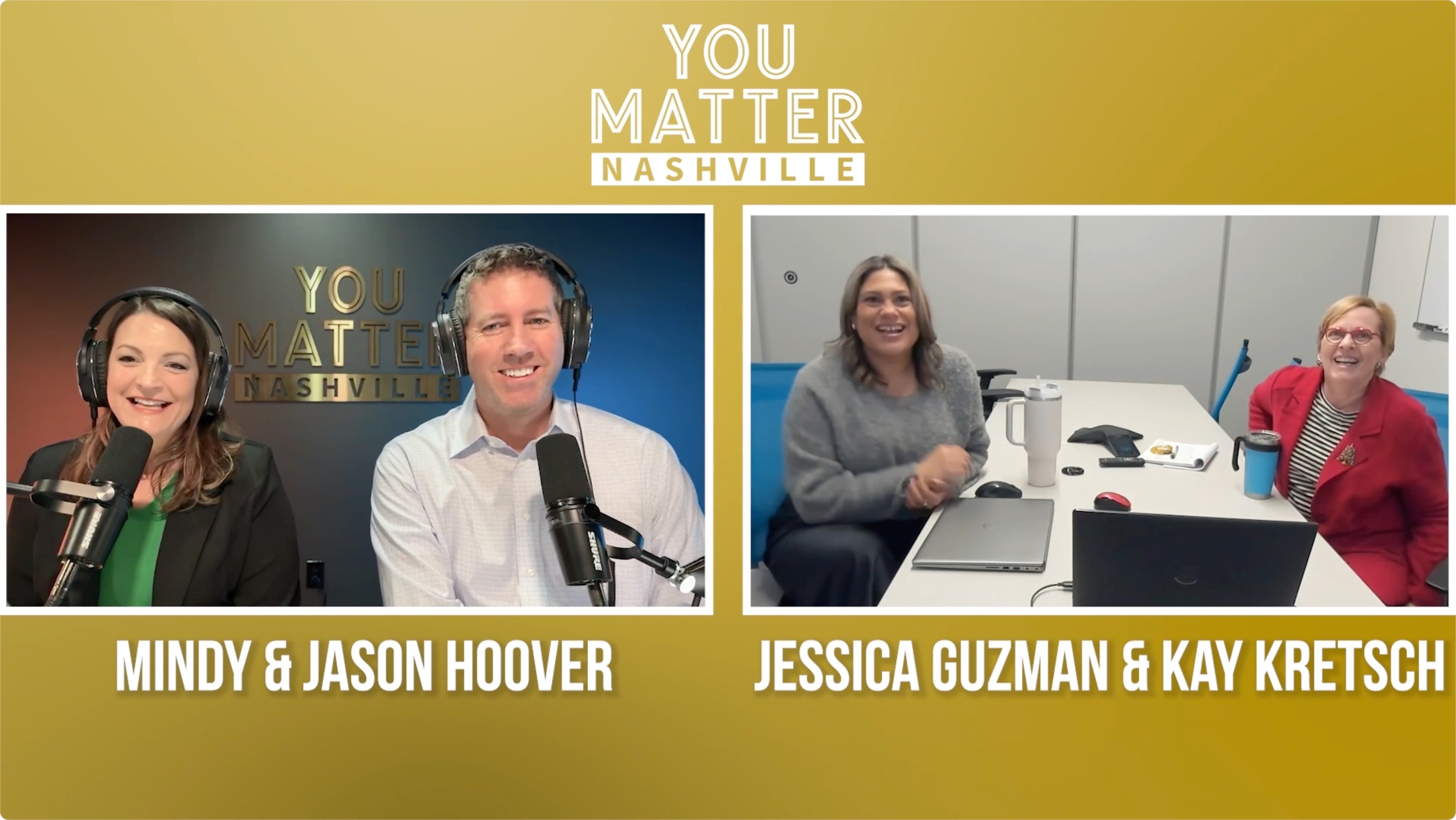
How the 21st District Recovery Court Rebuilds Lives
The 21st District Recovery Court is a nonprofit recovery court in Franklin, Tennessee, serving the 21st Judicial District. Led by Judge Deanna Bell Johnson and Executive Director Connie Martin, it offers people in the criminal justice system who are facing addiction a structured, multi-year path of treatment, accountability, and support instead of repeated incarceration. Learn more at 21stdc.org.
Listen to the episode
Jump to a moment
- 00:00, Welcome to You Matter Nashville
- 00:37, Meet Judge Deanna Bell Johnson
- 03:29, Meet Connie Martin
- 04:15, How the 21st District Recovery Court Works
- 06:24, Accountability, Treatment, and Graduation
- 07:19, Community Impact and Cost Savings
- 09:30, Funding the Program
- 11:51, A Sober Christmas and Family Restoration
- 16:13, Who Qualifies for Recovery Court?
- 18:15, Treating Trauma Behind Addiction
- 20:12, Why Long-Term Mental Health Treatment Matters
- 24:23, Sponsors and Peer Support
- 35:39, What Recovery Success Looks Like
- 40:46, Program Capacity and Services
- 45:36, Recovery, Reentry, and Prison Reform
- 53:40, Community Fundraisers and Future Growth
- 57:33, How to Support the Recovery Court
- 59:47, Donations and Volunteer Opportunities
This episode discusses addiction and the criminal justice system. If you or someone you know needs support, you can reach the SAMHSA National Helpline at 1-800-662-4357 or the 988 Suicide and Crisis Lifeline by calling or texting 988.
What does justice look like when the goal is to rebuild a life, not just close a case? On this episode of You Matter Nashville, Jason and Mindy Hoover sit down with Judge Deanna Bell Johnson and Executive Director Connie Martin of the 21st District Recovery Court.
What is the 21st District Recovery Court?
The 21st District Recovery Court is a nonprofit recovery court based in Franklin, in Tennessee's 21st Judicial District. It offers people in the criminal justice system who are facing addiction a structured path to a second chance instead of another cycle through incarceration.
Rather than punishment alone, the program surrounds participants with accountability, treatment, and the practical resources they need to succeed.
Who leads it?
Judge Deanna Bell Johnson has served on the bench in the 21st Judicial District since 2014, presiding over civil and criminal cases and taking a particular passion for recovery court. Connie Martin has been the recovery court's executive director since 2014, overseeing the day-to-day operations and the flow of the program.
Together they run a program built on a simple conviction: people are worth investing in.
"To be able to get maybe a second chance, or the resources they need to succeed."
How does the program work?
Recovery court is intensive and long-term. Participants commit to a demanding, multi-year process of treatment, supervision, accountability, and support, with the court and its team walking alongside them the whole way.
The aim is lasting change, addressing the addiction underneath the offense so that graduates can rejoin their families and community for good. Connie, who has run the program since 2014, keeps that flow moving day to day, connecting participants to treatment, supervision, and the resources they need to succeed.
Why does recovery court work?
Incarceration alone rarely touches the addiction driving an offense, so the same people cycle back through the system. Recovery court flips that script by treating the root cause, holding participants accountable while giving them the tools to actually change.
It is not the easy path. The program asks for real work over a long stretch of time, and it holds people to it. But that combination of high expectations and genuine support is exactly why graduates so often rebuild stable, sober lives and rejoin their families for good.
Where does it serve?
The 21st District Recovery Court serves Williamson County and Tennessee's 21st Judicial District, based in Franklin.
For Judge Johnson, the reward is watching people the system had written off become parents, employees, and neighbors again. Recovery court, she and Connie make clear, is not leniency; it is a harder, more hopeful road that asks everything of a participant and gives them a real shot at keeping it.
How can you help?
You can support the recovery court's work through the nonprofit that sustains it, and you can help by understanding and championing recovery court as a proven, humane alternative in your community. For anyone navigating the justice system or seeking treatment, the court's official site points to the right next step.
Judge Johnson and Connie Martin are proof that the justice system can be a doorway to healing. That is the kind of patient, redemptive work this community should be proud of.
Episode Resources
- Official site: 21stdc.org
- SAMHSA National Helpline: 1-800-662-4357
Ways to Help
Support the 21st District Recovery Court through the nonprofit that sustains it, and help by understanding and championing recovery court as a humane, effective alternative in your community. Anyone navigating the justice system or seeking treatment can find the right next step through the court's official site.
Guest Information
Deanna Bell Johnson
Deanna Bell Johnson is a judge in Tennessee's 21st Judicial District, where she has served on the bench since 2014, presiding over civil and criminal cases. She brings a particular passion to recovery court, helping lead the 21st District Recovery Court alongside its executive director. Outside the courtroom, she is an advocate for animal welfare and serves with the Friends of Williamson County Animal Center. Her work reflects a belief that the justice system can be a doorway to healing, not just punishment.
Connie Martin
Connie Martin is the executive director of the 21st District Recovery Court, a nonprofit recovery court based in Franklin, Tennessee. She has held the role since 2014, overseeing the program's operations and daily flow and connecting participants to treatment, supervision, and the resources they need to succeed. Her focus is helping people in the criminal justice system who are facing addiction find a genuine second chance and rebuild stable lives.
Visit this guest's websiteAbout the Organization
21st District Recovery Court
The 21st District Recovery Court is a nonprofit recovery court based in Franklin, serving Tennessee's 21st Judicial District in Williamson County. It offers people in the criminal justice system who are facing addiction a structured alternative to incarceration. Through an intensive, multi-year program of treatment, supervision, accountability, and support, the court works to address the addiction underneath the offense so participants can rebuild their lives and rejoin their families and community. Led by Judge Deanna Bell Johnson and Executive Director Connie Martin, its official site is 21stdc.org.
Visit the organization websiteKnow Someone Making a Difference?
Nominate a Middle Tennessee changemaker for a future You Matter Nashville episode.
Nominate a Guest21st District Recovery Court, 21stdc.org (official site, verified 2026-08-08). Episode interview with Judge Deanna Bell Johnson and Executive Director Connie Martin, You Matter Nashville. Program details are as described in the episode and on the official site; for eligibility and current services, see 21stdc.org.
Full transcript
Read
Speaker 1 (00:00.11)
Welcome to You Matter Nashville, where we celebrate the people and stories that make our community so special. We believe that everyone has a story to tell, and more importantly, everyone here matters.
We're your host Jason and Mindy Hoover and we're passionate about shining a light on individuals who are making a real impact right here in Middle Tennessee. This is about community, connection, and the incredible people who are making a difference.
Let's dive in as we uncover powerful stories and meet remarkable people whose journeys will inspire us all, right here on You Matter Nashville.
Speaker 1 (00:37.57)
Welcome back to another episode of You Matter Nashville. I'm Jason Hoover with my lovely wife, Mindy. And today we are honored to sit down with someone who has dedicated her life to service, justice, and the well-being of our community. Honorable Judge Deanna Bell Johnson, who serves as a circuit and chance to record judge right here in the 21st Judicial District of Tennessee. Welcome to this show, Judge Johnson.
Thank you very much for having me.
Now it says here that you have been on the bench since 2014, presiding over both civil and criminal cases, everything from DUIs and robbery to divorce and even complex business disputes. Before taking the bench, she built a remarkable legal career spanning labor and employment law, criminal defense, and federal practice. Judge Johnson is also involved in statewide judicial leadership and is passionate about recovery court.
Outside the courtroom, she's an advocate for animal welfare and serves as vice president of the Friends of Williamson County Animal Center.
Hi Judge Johnson and Connie. How are you ladies doing today? Doing great. Thank you. How about we start off by sharing what first led you into the world of law and public service? Well, as you just stated, I'm a big animal lover and I actually wanted to be a veterinarian, I realized I'm not good with blood. I also thought about the idea of putting animals to sleep would not go well for me. So I was in 10th grade.
Speaker 3 (01:43.361)
doing great.
Speaker 2 (02:08.182)
And I had a class on government and thought, I want to be a lawyer. And so I went with that track. And then once I started practicing law, I thought, I want to be a judge. And so the opportunity arose in 2014 and I pursued it and it's been great ever since.
Amazing that you wanted to be a vet first. So many people. Well, one thing, let me back up. I did not realize it took so much schooling to be a vet, just like a medical doctor.
Right? And I've heard that it's harder to get into veterinarian school than it is hospital school. Yeah, because more people want to work with animals. But just like you were saying, my aunt wanted to be a veterinarian all growing up. And then she was getting, she was in college for pre-med. She was like, I'm to be going to school for a long time for a little money and I have to put animals down. Like the thought of that, she was like, I can't do it. So she went into dentistry.
But she wanted to be a vet because she loved animals. But just like you, she's like, I don't have the heart to put an animal down. So I get it. mean, you have that's another level of, I think, consciousness that you be able to go, I'm doing this for the betterment of the animal all that stuff. So it's just hard. So I agree. If you love animals, you're good people. That is truth. That is true.
But it shows you're
Speaker 1 (03:29.036)
Now we also have with us today, Connie. Hey, Connie.
Hey,
Why don't you share a little bit about who you are and what you do and we'll just kind of go from there.
Okay. I'm the executive director of the 21st district recovery court, which we are a nonprofit organization located in Franklin. And I have been in this position since 2014. And so I oversee just all the operations and the flow of the program and trying to help people in the criminal justice system to
to be able to get maybe a second chance or the resources they need to succeed.
Speaker 1 (04:15.512)
So how about we share with our audience exactly what is it that this organization does and how it impacts people that are part of it and even the community.
I'll be happy to do that. So people who are, we call them our participants who are in our program are in the criminal justice system and they're charged with nonviolent offenses, usually theft, drug offenses where they're either stealing to get the money to support their drug habit or selling drugs to get the money to support their drug habit. So they're charged with a criminal offense or offenses. then
Part of their plea agreement with the state is that they get placed on probation and as a condition of their probation, they have to complete our recovery court program. And it's about a two year program. Sometimes people have some, what we call hiccups, a little backsliding throughout the program and they take a little longer than two years. But in order to what we call graduate, they have to remain clean for at least one year. And so we...
We have them, they come into our program. They're almost always in custody at the time. And so we immediately send them to an intensive inpatient treatment program, either 30 days at the minimum, usually six months, nine months or a year, because these are people who have been using drugs for a very long time, 20, 30 years, and not just using minor drugs, they're using fentanyl, heroin, cocaine.
And so they've been doing this a long time. A lot of them have been in treatment programs before, but it just didn't work for them and they relapsed. And so we send them to very intensive programs. then when they finish that program, they come back to us. They live in our housing. They're of course still on probation. They have a lot of rules. They have curfews. They have to maintain employment. They have to pay a little bit toward their housing.
Speaker 2 (06:24.622)
Not a lot, but a little bit toward that. They're drug tested several randomly and regularly several times a week. They are required to come to court once a week. They go to different AA, NA kind of meetings. We also have mental health treatment and all kinds of treatment for them in our program. And once they have that...
graduation date, then they move on and we have a very high success rate right now. We have, we're at about a 100 % graduation rate right now. Now that, yeah, because we're, we just have guys and gals who are doing great in the program and they are doing very, very well. I started presiding over this drug court or recovery court in 2022, August of 2022. So I've been out at a little over three years.
Wow.
Speaker 2 (07:19.118)
And so far, the ones who have graduated are doing great in life. know, they go on to, some of them get further education, some of them continue with employment. They reunite, of course, with their families who are so glad to have them back. And we just have a really high success rate. And one big advantage for taxpayers is to incarcerate somebody is $45,000 a year, approximately, here in Williamson County.
but for our program it's about $15,000 a year. that's a bargain. third. Yeah, it is. And Connie can tell you about how we're funded, not through the government, although we do get some government grants, but most of it is fundraising. That's incredible. Connie, how do you guys fundraise?
Well, we have two fundraisers that we do per year right now. One is our songwriter night, which is held in April. And one of our board members, Brett Warren of the Warren Brothers, assists us with this. so that is one source of revenue. And also we have a community lunch in the fall, usually in October.
And this is for community awareness as well as we also have a graduate that comes back and shares her story, which is very powerful. just, you know, helping the community to understand that our goal is not only, obviously, you know, we're saving taxpayers money too, but saving lives too. And that every one of our participants is an individual, a human being that often
got into this either through family relationships, through bad choices, through sometimes just medication, pain medication that they started taking for a legitimate accident. We've had so many different people with all of this that you just never know. And we want, I guess, our general public to understand that these are good people and they've made some bad choices.
Speaker 3 (09:30.478)
and we do stay in touch with them. And it's just really amazing that the transformation and that happens. So the fundraising piece is huge because we do apply and get some grants from the state. One now that we have from the federal government that we haven't had in a long time, but these grants are never guaranteed. And so, you know, we have to operate on the idea that was since we are a
and so nonprofit that, you we have to have backup for sure. But we have managed to stay afloat all these years. And always working on our donations, things like that too, for people to understand what they're giving to.
Education is important, absolutely. for sure. know Jason and I both grew up in places where drugs were prevalent. And I grew up in the Ozarks, where it wasn't when I was small that when it was time for me to go to college, methamphetamines just flooded the area. people, good people that I knew growing up that were in my friend group, it was to see the...
The good kids that I grew up with get on drugs. It broke my heart and see them being incarcerated and going to prison. And there's not enough programs or there's not enough judges who will push for that, push for them to go into long-term facilities. Yeah. Advocate for that. So this is a very special program that you guys are doing. Well, thank you. We love it and it's Christmas time. So I'll tell you, I share with you.
little story about what I've been doing. Of course, when they come to court, some of them have court once a week, some have court every other week. As they progress in the program, they come less frequently, but they always come at least once a month. And so every January I'll say, so how was your Christmas? How did it feel to have Christmas sober and clean and clear headed? Judge, it's great. And so last January, I had one guy said, Judge, I'll put it to you this way.
Speaker 2 (11:51.02)
been clean for a year or two. The last time I was clean at Christmas, my son was a year old and he's 21 now. missed all those years with his son being clean at Christmas time. And so every one of them said, it's just so great to actually get to interact with the family and have the spirit and the fun and all that of Christmas.
clean and sober with a nice clear head. So that's always a special thing that we get to hear. I try to do extra things, like sometimes I'll make assignments for them. One time I did an assignment of come up with a song that speaks to your addiction. The lyrics speak to your addiction, whether it's when you were in the throes of addiction or now that you're coming out in victory. So we got all kinds of different, I said, I prefer country music, but if you want other, any genre is fine.
So of course, a lot of them did a lot of country music, but they wrote out their lyrics. So that was a fun little project we did. We also did one where I said, one of my favorite songs is a Brad Paisley song, Letter to Me, where he writes a letter to himself at 16 and gives himself advice. I said, do that to yourself right before you started using. And so we've gotten beautiful letters out of that project.
and it's just interesting to have them go back and give themselves advice of what to do and what not to do.
You know, I've funny I've often thought about what would I say to myself if I could go back and Yeah, I don't think anything matter. I would go back and just slap myself into reality. Like what are you thinking? Get your get right now we fortunately like Mindy said I mean, unfortunately we grew up in areas that had a lot of drug use and a lot of our friends but fortunately meeting I'm We never did the drugs so we
Speaker 1 (13:53.164)
We don't know what it is personally, like internally, but we know what it's like to be on that other side of watching people just kill themselves slowly and the heartache. you know, especially with family, you know, when your family members or your close friends are going through this, you know, I have gone to multiple funerals of overdoses and it's, it's a very sad situation. And
to know that there's programs like this that, you know, they made a mistake and it's a slippery slope, right? And a lot of times it's the lack of hope that I have found. And for somebody like the two of you and your organization, I think that has a lot to do with this success rate is that you are putting hope back into their lives.
Yeah, we certainly try to do that. know, Connie mentioned, you know, that these folks are great people. And some of the things, the facts I talk about with the recovery court people that I talk to them about to kind of cheer them up, but I also talk to people who are interested in our program. It's interesting to know that individuals with substance use disorders have an average IQ of 114, but the average person for people without substance abuse
disorder is 94. So there's all kinds of facts that I like to throw out there. Unfortunately, this is not a good fact that most people who are addicts relapse 17 times before they get clean for good. And researchers can, I talked about the IQ, researchers can predict with pretty good accuracy future substance dependence problems in children based on their IQ.
And researchers also feel like now that somebody's not really healed and clean and sober till they've been clean for between six and eight years. And it has to do with the brain. You you remember those commercials, this is your brain, this is your brain on drugs and what what drugs do to the human brain. So it really takes a long time before their brains can go from sort of a mush back to to complete healing. And sometimes they never totally heal. We know that as well, unfortunately.
Speaker 2 (16:13.9)
How do you guys find candidates? I know my dad has, he would always say, you know, your want to has to want to. Right. You know, so how do you find those ideal candidates that are ready to make a change? Is this something that you present or is this something that they come forward and say, I want this or both? They apply. They're in the criminal justice system. And as part of their probation, that's part of the negotiation between the defense attorney and the prosecuting attorney and the
one or the other will say, how about my client try drug court and see if that'll work out. And then they go through a whole application process. have experts actually who interview them and it's very intensive to interview to make sure it's a good fit that for one, they really want to get clean and they have to have, they have to score on what's called high needs.
for example, educational needs, housing needs, employment needs, that sort of thing, and high risk, high risk that they're gonna reoffend in the criminal justice system as well as reoffend in terms of their drug use. And so if they score high enough, and we discuss it, we have a group who has a meeting and we discuss the applicants and decide whether not that applicant would be a good fit for our program and.
Then if we all agree that it's a good fit for the program, then we decide to accept them and they enter the program after that.
So one thing that is being talked about a lot more nowadays is mental health and the mental illness. It used to be, know, us Gen Xers, you mentioned your brain on drugs and that popped up the skillet with the egg in it. So lot of younger people won't know what we're talking about. But I love that we're talking about mental illness because that is getting to the core of
Speaker 1 (18:15.598)
And that helps with the turnaround is to identify what's causing it. And so once you are able to identify the cause, then you can actually support the recovery. Are you able, and if not, no problems, but are you able to share when they're in that program, what types of classes or what types of
program or what type of program is it that they go through.
I'll make one comment on the mental health piece and then I'll kick it over to Connie to answer that so she can have some time on the podcast. But I will say, as you mentioned, I was a criminal defense attorney before I became a judge and I always noticed with my clients who were involved in drugs that they had some sort of trauma in their lives, know, injury as a child, I mean, emotional injury that they never got counseling for and so they decided to self-medicate.
And I'm a big believer that most people, that's how they got involved in drugs. Nobody says when the second grade teacher says, what do want to be when you grow up? Fireman, policeman, nobody says I want to be a drug addict. They just end up that way because I think they're trying to self-medicate an injury they didn't have counseling for. But I'll let Connie address the other piece of it.
Yes, have my treatment director takes care of all of our treatment needs and she's great and just very, very knowledgeable. And we have, I mean, they have individual sessions obviously with her, which is a big deal. Also, she sets them up for, we have several different groups such as Seeking Safety, such as MRT, which is more recognition therapy.
Speaker 3 (20:12.43)
in the yard there's lots and lots of different therapies trauma therapy is huge especially with a lot of our we have more men than we do women especially with a lot of our guys trauma therapy is very very much needed and thanks to some of the maybe the opiate grant money and things like that were able to access those resources and so they
I mean, if they had to pay for all the therapies that they get the benefit of, I mean, they couldn't do it. You or I probably couldn't do it either. It's, it's, mean, mental health therapy is expensive, but between all of the different groups and classes and individual therapies that we have and that we offer to them,
Nikki, our treatment professional, she knows better what they need than any of us do and what they need to do. And it's pretty amazing. So the whole time that they're in our two-year program, they're involved in some type of mental health therapy.
That's incredible. And that's just the key. I know Jason was hitting on it. The first 30 days is really just detoxing. for sure. They get to that 90 day mark and they start to feel a little bit of hope. But it really takes that six month, that one year for them to really start building habits. Because I know the programs that are one year are so much more successful than the six months, so much because they have to build those habits.
But to be over 80 % successful in a program is considered incredible. So you guys being a lot higher than that mark, that just speaks testament that that mental health piece is really being taken seriously. And it's not just, let's get together. it's also when you have the Christian places, they have Bible study, they have accountability, they have all these things. But when you also have programs that are really
Speaker 2 (22:22.168)
delving into the mental health portion and one-on-one. Everybody's problem's different. I think that's just incredible.
They are and I will tell you that whenever one of the reasons our program is two years and was designed that way is that usually it takes to get them to the year mark before their head starts to clear. Before they are actually making rational, some rational decisions. I mean, and so the first year can be a little challenging. And so the second year just builds upon what, you know, everything that they have been given.
Exactly.
Speaker 3 (22:59.01)
And there in Judge Johnson can even test that the folks that are in second year are mentally and emotionally in a lot in a much better place than those that are better in the first year. And so because we have seen and I've seen many, many treatment programs that are great. But if you don't have if they don't have the time, like you don't have the follow up, we we also have alumni groups. We have people that come back.
that's incredible.
And so, and then we invite the people in the program to come to some of those alumni groups so they can see people that have been successful after leaving us. So it's just, it's a really good mix.
Do you have like mentors, people who are when they're filing transitioning into society? I guess you would say they finished the two year program. Do you guys have like mentors come like, you know, the AA groups, DA groups have?
Well, they're required to have a sponsor the whole time they're in, the entire time they're in a recovery court. So they have to have a sponsor of their choosing. And so usually they keep the same sponsor, you know, if they've had it in the second, him or her in second year and they keep that same sponsor. and we have our treatment director does an aftercare plan when they leave us about goals, they stay in touch with them. So we have still have contact with them even after they leave us.
Speaker 3 (24:23.498)
And so, and most of them will follow up and they will keep their sponsor. And a lot of them will go on to later sponsor other people, which is incredible.
Which is the cycle you want. Because when you are then being the person to give accountability, you know, or, you know, and have and be that leader that just gives you so much more confidence, I think, you know. yeah. Sure. Back when I was a teacher, I was what we call a scaffolding teacher. And so I always empowered kids that were really good leaders. And as they rose to the ranks, would, you know, their mentor, they were the leader and then they mentored by the time they were juniors and seniors. Right.
I was a music teacher. it was, it's kind of that same mentality of they felt so important. They felt, you know, they feel really good about themselves, proud of themselves that they were in these positions to help people that were younger than them. And our people are that way. They love to encourage one another. Some of them work in recovery. They, after they've been in recovery in our program, have two or three who are currently working at recovery programs.
and they love giving back. And even the ones who don't work in recovery programs, they love giving back. They'll go and they'll speak to young people. They'll speak to other recovered people who need to be in recovery. They participate in different programs that let them give back. And they really like, they really enjoy doing that. I was just gonna give sort of a PSA, you know, for parents. What we're seeing a lot is something called, is sort of,
it's mushrooms, silo silo mushrooms, and they're putting them in chocolate bars. It looks like a sort of a, you know, those Hershey's chocolate bars that are like squares. And the kids think it's just really super cool to just break off of, you know, a bar and eat one and they get high and then they don't get high enough. So they eat another, you know, that kind of thing. We're seeing that. But what is really also very scary for parents, I think having had teenagers and young
Speaker 2 (26:35.82)
young adults is that if you are caught selling that to anyone, but if you're caught selling that, it is a class B felony and you face a minimum of eight years in prison at 100. Wow. And so you get some of these young, I've had a few in my criminal docket who are 19, 20 year old young men doing great in life, but thought that they'd
earn a few extra bucks selling some of this stuff and they get caught and then they're looking at eight years in the state penitentiary at 100%. There's no early release. That's crazy. It's schedule. It's scary for people because they need to know, the parents need to know about their kids who might be consuming those products, but also their young folks who might be trying to sell that stuff. It damages their lives as well.
I think they think it's like shrooms, like weed. It's kind of natural. It's not going to be that bad or big of a deal, but it's a completely different classification. And another sort of PSA I'll give as well. When I first have somebody come into the program, they come to court for the first time and I say, tell us about yourself. Where are from? You got kids? This kind of thing.
And obviously the main question I ask is how did you get started with drugs? And 99.9 % of the time it's with marijuana. And then it leads to cocaine and then heroin and methamphetamine. In fact, I did sort of an anecdotal poll the other day in court on Tuesday. And I had already asked these folks this, but just to keep my notes, I think I asked 20 different participants this same question. What was your first drug? And all but one said marijuana.
The one guy, was opioids that were given for I think a back injury or something. So that's a little bit of an outlier, but every other person, was marijuana that's what got them started on marijuana in drugs. And then it led to the harsher drugs that ruined their lives and the lives of their family members as well.
Speaker 1 (28:46.606)
You know, you had mentioned earlier that it's more men than women. Is there a known reason of why that may be?
Well, as far as that's just that are coming into our program right now. It's different in a few, several years ago, five or six years ago, we had a lot of women and it just depends on, mean, we have, our people are in the criminal justice system and sometimes we get more men that apply and then sometimes it's more women. just never, the need is equally great and the women have...
far, well, they have a lot, a lot, lot of issues and sometimes it just takes a while sometimes for them just to be able or to be ready to make a change. And so, so we take both. just right now we only have a, we have maybe three or four women compared to about 20 something men. So, but you never know. it's, it's, you know, a lot of similarities, but then there's a lot of other differences between the.
treatment too.
Okay. And there's been a lot of talk about the vaping, you know, and using, I guess, the marijuana. Yeah, because we've got kids that, you know, they're 22 and 16 in high school. So the have you seen is that as that perpetuated this?
Speaker 2 (30:09.122)
Yeah, marijuana vaping.
Speaker 2 (30:24.3)
made it easy.
Made it easier. you know, there's all these, I've seen where they have Skittles that, you know, looks like a Skittles bag and it's got cannabis in it. So I'm just curious, what are y'all seeing?
Well, I know that for our, and Judge Johnson may want to speak to this from the criminal part, but I know that with our folks, a lot of them vape, period. But it has gotten, I believe that has gotten a lot worse. And the products that are being used in these vapes now, I think are far more dangerous.
And so, and it's very, very addictive and it's so easy to get, I mean, and could be so deadly. And one of the reasons, you know, we drug test our folks minimum two to three times a week. And I mean, and that's for a reason. I mean, we just, you know, just to...
and sometimes we've been surprised them on a weekend drug test but the drugs out there today are far more deadly as Judge Johnson said than they've been you know in the years past and I mean it is you know making one bad decision could cost someone their lives. I mean because we you know our program is one of discipline a lot of other things and of hope.
Speaker 3 (31:59.278)
But we can we always have to bear in mind the gravity of it all too and what the reality of the population that we're serving and What can happen because it you know that is always a possibility But we do everything in our power to discourage it obviously through the frequent drug testing too But for people that are not even in our program. It's just really scary as to the things that's out there now
Yeah. And once they go through the program and they graduate, or, well, let me ask, do they, do you guys help them find a job or you graduate them and it's up to them?
That's part of their program is they have to find a job when they return from inpatient treatment. They have to have a job and they do not have any problem getting a job. And we assist them. We have a small staff, but we have a case manager. We have a peer support specialist that works with them on helping them with resources, jobs. And then Nikki takes care of treatment. We have someone else that helps with housing.
And we provide, you we have limited beds in our housing, but we help provide beds. they, almost everyone has no problem getting in, maintaining a job when they get out. And it is a requirement unless they're somehow disabled.
Yeah, let me say this. We are very grateful to the employers who are willing to employ them because these folks have felonies. Everyone, because they're in felony court, all these folks have pled guilty to felonies in order to be in our program because they have to have at least a two or three year sentence. We prefer a three year sentence to give a little wiggle room since it is a two year program and if they relapse, we have some extra time there.
Speaker 2 (33:50.634)
So they have to have at least a three year sentence, which is a felony. So we're very grateful to the local employer, local companies who employ them and are willing to give them a second chance, as well as we have some restaurant chains who do that as well. And we're so grateful to them for being willing to take a chance on these folks and give them a second chance.
Yeah. Yeah. It that and that that is a big part of them, I guess, feeling better about themselves. Yes. You know, I heard someone say long time ago and it stuck with me is when always envision people wearing a sign around their neck that says make me feel special. And, you know, that
has resonated. like, we all want to feel special. And it's kind of one of the reasons we started the podcast is everybody wants to know they matter in this world. And we do. Everybody has a purpose. Everybody does matter. Sometimes life comes at you sideways. Sometimes life, you know, just doesn't go the way that you wanted and you end up in, you know, not so good situations. I
I reading here, I've got some notes here I took earlier. I was reading here about opioids and one of the stats said that Tennessee consistently ranks among the top 10 states for opioid misuse. But they followed it up talking about opioid connected arrest and theft related crimes decline in communities where recovery courts have strong treatment partnerships.
out.
Speaker 1 (35:39.375)
And I think our community is not aware of that.
that it does work. I think that a lot of people think it doesn't work, you know, and or it just doesn't work for enough people. You know, they see people who have fallen out of programs because like you said, you know, sometimes it takes multiple times before it sticks. But I think so many people just look at the failure rate, you know, instead of looking at the success rate. That's true. Yes. And if you come to one of our graduations and you hear
when we have the graduates sitting there and their mom or their wife or their father, usually mama, is in the audience. And that's what always gets me choked up as a mama when the mama talks about how you saved my son or how you saved my daughter and changed our family. It's very moving. And so for that one person, that one family, it's life-changing and it's definitely worth it.
when we see those victories.
I can only imagine seeing your child finally, because I'm sure they worry, stress, pray, and the pain that they go through day in and day out wondering if their child's going to wake up they're going to wake up and hear a terrible news that they passed. Like I said, some of those funerals that I've been at with the OD, their family devastated, absolutely devastated.
Speaker 1 (37:14.19)
So, you know, not only are people like you helping those individuals, but you're you're helping so many more that are connected with them and yeah, I can imagine just the the I Don't know that that just relief maybe that they are feeling that they finally broke through and Turned their life around Yeah, that's a
That'd be very touching to see that.
It is, you know, they'll talk about, haven't seen my son in two years or I haven't had any conversations with my father in 10 years. And so we're reuniting families. We're seeing them reunite with their own children or their grandchildren or their parents. And it's wonderful to see.
I it is. Now, what are some of the obstacles that this program, you face with the program? I know we talked about a little bit about money. So outside of that, what kind of obstacles do you face?
Go ahead, Cami.
Speaker 3 (38:28.968)
Right now, Judge Johnson probably can speak to this as well, but right now, the housing piece is huge. Because as you all know, housing is very expensive. is. And we have been very blessed to be able to purchase some property down on Natchez Street in Franklin. And we do have a small house of three beds for women.
Yeah.
Speaker 3 (38:56.076)
And we're and we're working on trying to transform one of the other buildings into office space so that we can use the building we're in right now and have five more beds for for more participants. But we lease from Community House in Partnership 10 beds and and we pay rent for those so that they they you know they will have a place to live. But outside that you know we're working on.
trying to buy some other property just to be able to create housing. So housing is just a big issue here because we have, you know, we have about 42 people in the program and about half of them are in some type of long-term treatment program, which means they've gone six months to a year, but eventually they come back. So we're always not sure when they come back, going to have, we know we're going to have housing. So far it has worked out.
but we're always looking at opportunities for, you know, to partner with people for housing. But it is harder when you have folks that are, for the most part, convicted felons. Yeah. Right. So, and even though we're paying the rent, obviously, it's still more difficult. But the community has, the landscape of all the community has changed over the last few years too. And I think more people,
Maybe understand a little bit more of some of the challenges that we're facing, but we're moving forward and hopefully if all this works out, we'll be able to add, think 10 more, think it's either 10 or 15 more beds for our program, which would be huge. So that's probably the biggest, biggest challenge right there is housing. Right, right.
you could grow if you had more housing.
Speaker 1 (40:46.958)
Right. How many do y'all typically have in the program at a time?
Well, of the 40 or 42 that we have, somewhere between 35 and 40, and like I said, some are in different places, which is how far long-term, short-term, or outpatient, which is where they're out and they're coming in to us. So it's just a mix, usually somewhere from 35 to 45.
Okay. I was looking at your website. I love the website, by the way. The under programs and services, it lists out what we've talked about here. And you had mentioned MRT. So I was curious of what the MRT stood for, it's a moral recognition therapy. Yes. Are you able to speak a little bit to that? What's that like? It says something about a 12 step.
Well, it is very similar. It's not the 12 steps like in AA or NA, but it's a different, there's different steps that our folks have to present with reasoning and I guess that's why they call it the moral recognition therapy of these different steps. And I could not repeat what all the steps are, but they go through each step.
And when they whenever they do each person has to go through all 12 steps and they have to present a step like every week or every other week and they present it to their peers and their peers are the ones that vote whether or not they did a well a good enough job to pass that step. Yes. And it's so it's very intense. So it's and it really helps them to reason.
Speaker 1 (42:28.48)
wow, okay.
Hahaha
Speaker 3 (42:37.272)
things. mean, it's really amazing if you really think about it. It's very involved. And so they have that. I mean, this process takes several months and everyone has to complete those. but it does, helps him to think differently. You know, it's really interesting.
I bet it is. We've had different organizations on the podcast and talking about therapy and just what's that neurofeedback, which is, I guess it's fairly new, my understanding. it's encouraging the more we're starting to learn about the brain and how to change the brain for people.
like this and because it can change as we stated earlier in the earlier in the this episode that it's more than 21 days. I think we've got this false idea. Somebody told us that change or changing a habit or making a habit takes 21 days.
But we're all laughing like, no, yeah, no. I'm too stubborn for some.
But, you know, seriously taking a year, two years to really get that change and to have a program that supports somebody through this. I love that that is, that you guys are doing it. And also read on here that, that there's 75 recovery court type programs just in Tennessee alone. And that's fantastic.
Speaker 3 (44:19.618)
is.
Yeah, here in Williamson County, we've got several, we've got, of course, what we have was just recovery court. used to be called drug court, but Tennessee changed it to recovery court. Nationwide, most states still call it drug court. But in Williamson County, we also have a veterans court, which is for obviously veterans. They have some different challenges and they're caught up in the criminal justice system as well. And so they have different needs and different things going on in their lives.
We have mental health court. All of these are in the criminal justice system. And then we also have DUI court. So it's very similar to recovery court, but focusing on people with alcohol addictions and people who are going through that with DUIs. And it's not just like first defense DUIs. It's somebody with four or five different DUIs, that kind of thing, where they're struggling. They're obviously alcohol.
an alcoholic and they're struggling with that. And then we have a program here in Williamson County also called 10 Rocks, which is a similar program for people with drug and alcohol, but not as intense as the recovery court program we have.
okay.
Speaker 2 (45:36.076)
I just wish that these were all available in long-term prison situations. know a lot of prisons, don't offer these programs. We're both for prison reform. We've talked through a lot of this. Like we said, unfortunately, we've had childhood friends that have gone that route. They came out and they went back in. It's just a cycle. They did not get the training. They did not get the mental help that they needed while in class.
incarcerated. So they're just sitting there, you know, day in and day out with the, you know, just going over the same problems in their head over and over. They're not having anyone intervene. Yeah, most likely to re-offend. Why aren't we implementing these therapies and really working with these men and women to keep the cycle from happening? It's almost like the cycle.
They're more likely to reoffend.
Speaker 2 (46:33.171)
is I don't know, are putting Band-Aids on situations.
Do you all see maybe a trend? you see more programs are happening and we're moving to that way of trying to help the people rather than just incarcerate them?
We do. started, drug court started back in the 1990s with a judge in Miami who was just seeing people come in and out. You put them in prison, they'd come back, come back to court revolving door. And he said, I got to do something different. It's not working what we're doing. So he started, you know, doing a drug court program and it just sort of took off throughout the nation. And then in the late 1990s or meant to late 1990s, Judge Seth Norman, who has now passed.
but up in Nashville, he started a drug court up there called DC4. He was fourth division. anyway, so he started it for the state of Tennessee. And now every judicial district in Tennessee has a recovery court. so that was kind of the first of what we call now the umbrella sort of treatment courts. And so the first one was recovery court. And then now we've got, like I was saying,
the Veterans and the Mental Health Court and the DUI courts. We've got those throughout the state. Not every judicial district has one of those kinds of courts, but they're popping up and judges are taking the bull by the horns and starting these different courts in their judicial district throughout Tennessee and throughout the nation and getting these kinds of things going. But for Recovery Court, probably because it was the original treatment,
Speaker 2 (48:15.95)
court in the nation. We have one in every judicial district now in Tennessee. Fantastic. Wonderful. And I think pretty much every state has, again, they call it drug court, but I think every state has drug court now.
That's fantastic. You had mentioned that you have about 100 % graduation rate.
Right now now. Yeah, I right now is which is good knock
So is that, well, it's still, I would imagine it's still pretty high overall as an average. Is that unique to the Williamson County or do you see that's pretty much the same story across the board?
know about that. I think ours is just kind of high right now. I think typically for recovery court, just in general or drug court in general, it is about an 85 to 90 % graduation rate. So success rate, those who come into the program successfully complete it and then what we call graduate now and then they go on in their lives and it's kind of hard to track because they could move to another state.
Speaker 2 (49:34.146)
But we have a good percentage of those folks, once they graduate, staying clean. And I think that's pretty good statewide.
Yeah. Okay. That's, I mean, that's amazing. like Mindy said, I wish we had more of these before, but Hey, I'm glad it started, you know, even in the 1990s, yeah. And especially, you know, the drugs are getting more and more lethal. I was watching, I think one of the news programs and they said there's a new one that's even more lethal than fentanyl.
And it's like more lethal than that. I mean, why? Why?
Chasing the high, just keep on creating something more and more. I guess. know, it's something we had talked to our kids because, know, we do have, unfortunately, you know, addiction in our families. And, you know, and we are just very, you know, like, you know, some people can have a drink and some people have a drink and they have to have 10 more. And you don't know what your body chemistry, how it's going to react. You are playing Russian roulette if you have that in your
in your bloodstream, you know, if you're genetically inclined that you could be an addict, why would you even play around with that? You know? And so I started talking to the kids about that when they were probably in middle school, you know, when drugs are being introduced, I'm like, you're playing Russian roulette. You don't know, you have 50-50 chance of becoming an addict. Why chance it? Don't do it.
Speaker 1 (51:08.706)
I think Nancy Reagan scared me with the whole, just say no, that you take it and you're addicted and you die. That's the way I believed it.
I'm blessed Nancy Reagan. seriously, yeah, Nancy was a huge proponent. And just speaking against it, because that's when it started getting, that's when the methamphetamines and all the opioids started kind of sweeping the nation. And in the medical, a lot of people became addicted in the 80s and 90s and still now on opioids. I can't even say it today. you. Opioids. Opioids. Yes. Opioids.
It Nancy,
Speaker 2 (51:45.846)
And we're starting to, you know, we're still seeing the repercussions from that, which is sad. but all in all, think it's just having lots of conversations with your kids, being very vigilant and knowing where your kids are, who they hang out with. I mean, you can do all of that and it still happened, but you know, I just think it's just so important to really just be, you know, just be that parent.
be that parent that knows and is nosy and being involved, being the house that the kids go and play at, even though sometimes... The landing pad. That's been our house for all of our, both of our kids, but because we want to know who they're hanging out with and what they're doing. you know, say, you know, make good choices. Don't do drugs.
being involved.
Speaker 1 (52:21.951)
in the
Speaker 2 (52:40.206)
You know, but I mean, it's a joke, but it's not. It's like I'm watching out and paying attention. And they know I was a school teacher, a high school teacher for 15 years. said, I can smell weed two blocks away. Don't even try it. I'm gonna know. Yeah, I can smell the lye.
and you can smell a lot.
Yeah.
So looking forward, you all have done so much and you have such a fantastic recovery rate, graduation rate. Looking forward, what does the future look like for this program in particular or maybe as a whole?
Well, think Connie mentioned it, trying to grow, you know, if we can save more lives, you know, if we have more participants, which leads back to the housing issue, the funding issue, we want to grow the program so that we can save more lives.
Speaker 1 (53:40.552)
Saving. Yeah. And our, one thing that I could not find, I know there's a lot more programs like this. Do you see that it's continuing that more and more of these are coming, are doing this type of, I guess, therapy type programs?
I mean, as far as the state or the country.
So and I think as medical personnel find out more things, more ways to help addicts. Connie was mentioning the different therapies and as science progresses and we see better ways to help folks to heal the brain, then I think programs will get better and better and maybe more programs will be developed. may have heard Jelly Roll is
starting a program out in Murphy's Pearl, which I think is fabulous. Let me give a shout out to him. know, Ms. Martin mentioned the songwriter fundraiser we have in April. The first one we had was a couple years ago with Tim McGraw. He came and they, of course, donate their time and he raised a ton of money for us and we sold out less than 24 hours.
Joe.
Speaker 2 (55:02.322)
Then next year we had Martina McBride, was, she was fabulous. She came and entertained. It was at the Franklin Theater. then last year, well this year, in April of this year, we had two artists who were supposed to come out and that was planned like six months in advance. And on like the Sunday before the Thursday event, both of them bailed on us.
And our board member who had hooked all that up, he's involved in the music business. He's a songwriter himself. Brett Warren and his brother Brad Warren always do, they're part of the show as well, the songwriter show. great. They did Red Solo Cup, that song, and a ton of other great songs. At any rate, Brett reached out to Jelly Roll and said, hey, we're in a real bad bind. Can you help us out? I know it's five days away. And Jelly Roll, I believe the story,
what I was told is he was just getting off an airplane from being out on the road and said, I got your back brother. And sure enough, that Thursday, he showed up. knew. And Brett introduced it and said, bad news. And I won't name the artist. So and so and so and so couldn't make it. But we have Jelly Roll. So he was taking his place. And here comes Jelly Roll out on the stage.
went nuts. was just one Jaws dropped. For him to do that for us, not planned, five days out, for him to drop everything and come bail us out, I'm his biggest fan now. Absolutely, we are too.
We're huge Jelly Roll fans. I started out, the whole reason I moved up here was music business and ended up graduating from Belmont. I've never had, I never got starstruck or anything, but I would love to actually meet Jelly Roll. I don't think I've ever said that about maybe one other artist.
Speaker 1 (57:11.02)
Like I just love his heart and his story, his redemption. And then he's not, mean, he, seems humbling. Yeah. He seems like, Hey, this is where I came from. This is what I'm doing. And just like this, he's going to go out and pour into others any way possible. And like, how much better would the world be if we had more jelly rolls?
story.
Speaker 2 (57:33.044)
Right. And I'm a huge Martina McBride fan. And I'm so sad that she barely makes appearances anymore. So if I would have known that, I would have gotten tickets. talking about just funding and fundraising, I know we touched a little bit on it earlier and we're hitting it now. But what other ways can people throughout the year be able to help you guys with funding or give a donation? What do they need to do?
So they can just go to our website, 21st Recovery Court, and there are ways to give online. And they can also be looking for that April date coming up for our Songwriters' Night if they want. And y'all, we'll try to remember to invite y'all, let you know. we'll get jelly roll it back. the folks can just look at the website again, 21st District Recovery Court.
And then we have the luncheon as well in October. They're welcome to attend. And we have a giving campaign there at the end of the luncheon. So we'd love to have the help and we appreciate any help we can get. Is there any donations other than money that you guys need throughout the year? And are there any volunteer opportunities? Sure. And I'll let Connie talk about that.
As far as other donations and things, do have, sometimes we'll have other agencies or people we had that will call me and say, hey, I've got copy paper that we don't need, or I have file focus, you need it, you know, and sometimes they're just individuals.
And so those, you know, different things, if we can't use them, usually we know someone else or maybe another nonprofit that can use them. And so we've had, you know, actually items that have been donated by members of the community. Also, we do, I've really started encouraging folks, we have a couple of people that they donate $25 a month.
Speaker 3 (59:47.5)
And people think that that's what it adds up. It adds up. And I'm so I mean, I just think that's wonderful. And so we are encouraging people to, know, even if it's a small amount. I mean, it all adds up. really does. And so if they have if people have want to do either types of donations, contact me. Volunteering is a little different because this is treatment related.
And sometimes there's different ways to volunteer, such as we have some folks from like St. Paul's men's group that they'll smoke some turkeys and bring it to us periodically, you know, which is nice. That's wonderful. But the kind of volunteering is different than really hands-on stuff because most of that stuff, you know, we have to respect the privacy of a treatment, know, treatment services. So, but...
But the graduations and the court sessions are open to the public if someone wants to come in and just to see what that really looks like. Because every Tuesday at 5 o'clock, except for holidays or some specific days, almost all Tuesdays at 5 o'clock, Judge Johnson's there presiding over recovery court. It's held at one of the juvenile courtrooms at the jail. And so people are encouraged to come in to see.
Well, that's, this has been just amazing or enlightening to conversation, you know, and it's right here in our backyard. We didn't even know about it. So I'm so grateful that, you guys are, you were nominated to be on here and, that's, it's people like you that it's people like you guys that are making.
this community, making, you know, just, I guess the whole state better, or maybe even the whole United States. But anyway, right here in our community, we thank you for doing that and it's very much needed. I'm glad we're as a community making the changes to pour into people and understand, Hey, we all make mistakes. you know, some of them include drugs or alcohol, you know, sometimes we do make those bad choices and, you know,
Speaker 1 (01:02:11.796)
as most of them, it's because of a reason. Like you said, Judge Johnson is that nobody says they want to be a drug addict. That's not on anybody's future list. Their five or 10 year goals is never for something like that. And it just, happens. And we've got to be a more forgiving society. And the thing is there is good in those people.
There are good, there's good in them. And as a community, we can bring that out and it's people like you that are doing it. So I appreciate both of you for sharing your story and sharing your heart. I know we can definitely see that you guys have a pure heart and you love what you do. You love the difference that you're making and we thank you for that.
Yes. We're grateful for your leadership and your compassion here and thank you for being on the show. Thank you for this opportunity. We appreciate it. It's been fun. So I appreciate it.
Thank you for having us.
Speaker 1 (01:03:17.358)
Yeah, yeah.
Speaker 1 (01:03:24.226)
Great. All right, that's a wrap, everybody. Thank you for tuning in and listening. And as always, until next time, remember that you matter.
Thank you for joining us on this episode of You Matter Nashville. We hope you found inspiration on this episode and are reminded that no matter where you are or what you do, you matter.
If you enjoyed this episode, please be sure to subscribe, leave us a review, and even share it with your friends and family. Also, stay connected with us on social media and tune in next time for more incredible stories from the heart of our community.
Until then, remember, your story matters, your voice matters, and most of all, you matter.