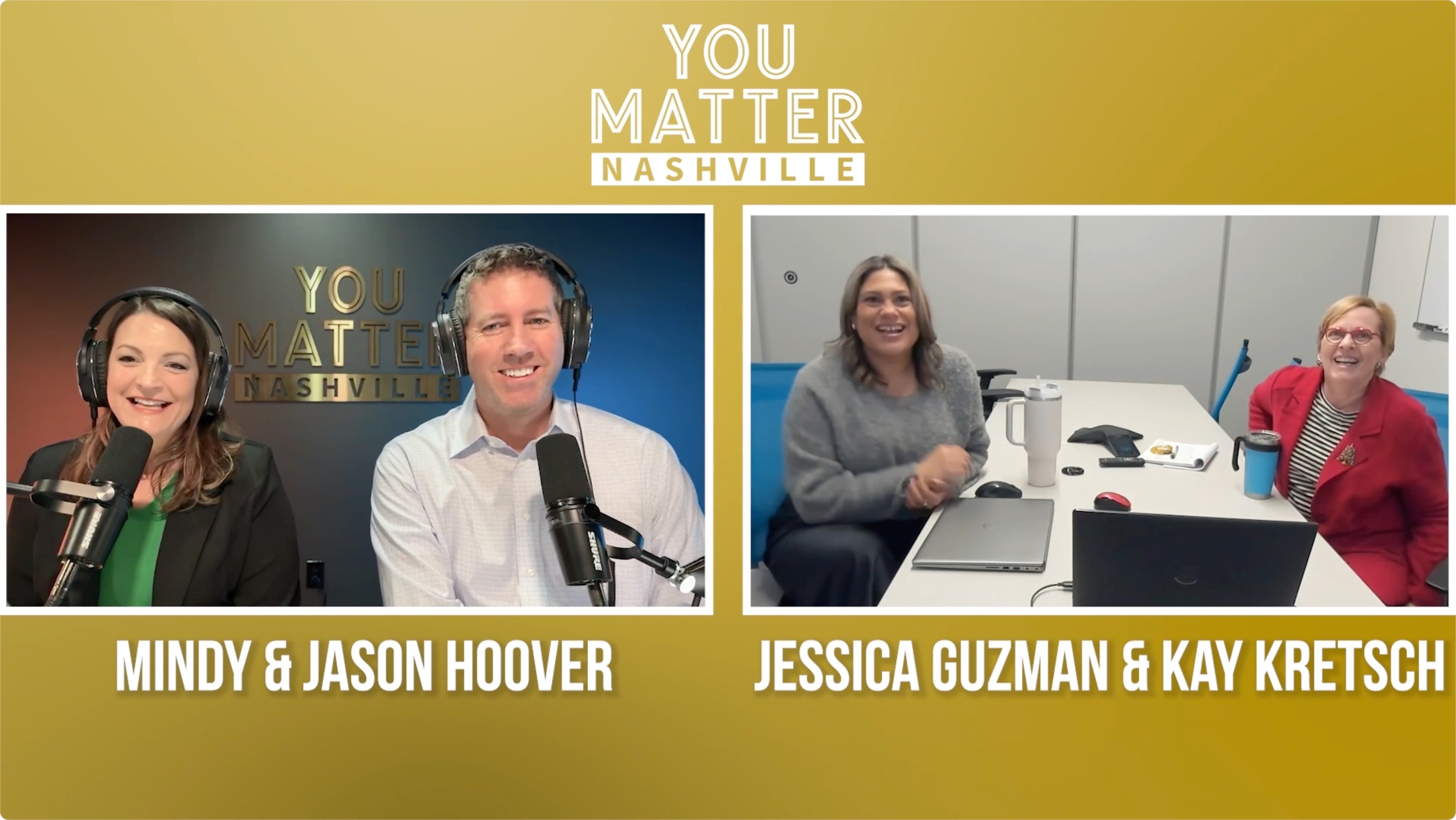
Nathan Scarlett Is Working to House 503 Nashville Neighbors
People Loving Nashville is a faith-based nonprofit that provides services and relationship-centered street outreach to neighbors experiencing homelessness. Outreach specialist Nathan Scarlett has done this work for more than 12 years and aims to permanently house 503 people before he retires, having already helped 155. Learn more or get involved at peoplelovingnashville.com.
Listen to the episode
Jump to a moment
- 00:00, Welcome to You Matter Nashville
- 01:01, Nathan's Journey into Outreach
- 10:48, The Mission of People Loving Nashville
- 18:12, The Origins of People Loving Nashville
- 23:20, Advocacy Through Personal Experience
- 30:07, Building Connections and Community
- 32:03, Understanding Homelessness: Beyond the Surface
- 33:45, The Housing Crisis in Nashville
- 36:36, Barriers to Housing: Who Falls Through the Cracks?
- 39:22, Setting Goals: Aiming for 500 Homes
- 42:04, Preventing Burnout in Outreach Work
- 49:20, The Power of Saying No
- 52:22, Faith in Action: Stories of Hope
- 56:15, Community Involvement: How to Help the Homeless
How do you house 503 neighbors? One relationship at a time. On this episode of You Matter Nashville, Jason and Mindy Hoover sit down with Nathan Scarlett, outreach specialist with People Loving Nashville.
What is People Loving Nashville?
People Loving Nashville is a faith-based nonprofit that provides services and relationship-centered street outreach to neighbors experiencing homelessness. The heart of it is dignity: people who are unhoused deserve to be seen, heard, and cared for as people, not problems.
Rather than a one-time handout, the ministry builds real relationships over time, which is what opens the door to lasting change, including a path into housing.
Who is Nathan Scarlett?
Nathan has done street outreach and housing navigation in Nashville for more than twelve years. He carries a specific, audacious goal: to permanently house 503 people before he retires, and he has already helped 155 find their way home.
His path was anything but straight. He once wanted to chase storms as a meteorologist, spent time in Costa Rica after selling everything he owned, and kept following a pull toward serving others until this became his life's work.
How did it begin?
The seed was planted in 2007. As a college student at Western Kentucky University, Nathan and a few friends bought apple pies, cheeseburgers, and sodas from McDonald's and headed to the downtown Nashville streets to share food and offer prayer.
Word spread among the people they met, and a simple act of showing up became the start of a calling.
What does the number 503 mean?
Nathan's goal isn't a vague hope to help more people; it's a specific, countable promise to permanently house 503 neighbors before he retires. Naming a number turns compassion into accountability and keeps the mission concrete.
Each of the 155 already housed is a real person with a name and a story, reached not through a single handout but through months of showing up. The remaining number is a reminder that the work is unfinished, and worth finishing.
Why does relationship-centered outreach work?
Housing someone isn't just paperwork; it's trust. By showing up consistently and treating people with dignity, Nathan and his team earn the relationship that makes navigation, and a real move indoors, possible.
That patient, person-first approach is exactly why the goal isn't a handout count but a number of neighbors permanently housed.
How can you help?
You can volunteer to serve alongside the outreach team, donate to support the work, or simply learn to see and greet unhoused neighbors as people. Every bit helps move someone closer to being housed.
Nathan turned a night of apple pies into a twelve-year mission to bring people home. That is the kind of steady, faithful love this community is built on.
Episode Resources
- Official site: peoplelovingnashville.com
- Volunteer and donate: peoplelovingnashville.com
Ways to Help
Support People Loving Nashville by volunteering alongside the outreach team, donating to fund the work, or simply learning to see and greet unhoused neighbors as people worthy of dignity.
Guest Information
Nathan Scarlett
Nathan Scarlett is an outreach specialist with People Loving Nashville, a faith-based ministry to neighbors experiencing homelessness. He has done street outreach and housing navigation in Nashville for more than twelve years and carries a specific goal: to permanently house 503 people before he retires, having already helped 155. His work began in 2007, sharing food and prayer on downtown Nashville streets, and is built on treating people with dignity and building the relationships that open the door to housing.
About the Organization
People Loving Nashville
People Loving Nashville is a faith-based nonprofit that provides services and relationship-centered street outreach to neighbors experiencing homelessness. Its guiding value is dignity: making sure people who are unhoused are seen, heard, and cared for as people. The ministry traces back to 2007, when a group of college students began sharing food and prayer on downtown Nashville streets, and today its team of staff and volunteers builds the long-term relationships that open the door to housing. Its official site is peoplelovingnashville.com.
Visit the organization websiteKnow Someone Making a Difference?
Nominate a Middle Tennessee changemaker for a future You Matter Nashville episode.
Nominate a GuestPeople Loving Nashville, peoplelovingnashville.com (official site, verified 2026-08-08). Episode interview with outreach specialist Nathan Scarlett, You Matter Nashville. The goal of housing 503 people and the count of 155 helped are as stated by the guest in the episode.
Full transcript
Read
Speaker 2 (00:00)
Welcome to You Matter Nashville, where we celebrate the people and stories that make our community so special. We believe that everyone has a story to tell, and more importantly, everyone here matters.
Speaker 1 (00:11)
We're your host, Jason and Mindy Hoover, and we're passionate about shining a light on individuals who are making a real impact right here in Middle Tennessee. This is about community, connection, and the incredible people who are making a difference.
Speaker 2 (00:25)
Let's dive in as we uncover powerful stories and meet remarkable people whose journeys will inspire us all, right here on You Matter Nashville.
Hello friends. Welcome back to You Matter Nashville. I am Jason Hoover along with my absolutely beautiful wife of 19 years, Mindy Hoover. Thank you so much for tuning in. We've got a very special guest with us today. It is Mr. Nathan Scarlett. He is the outreach specialist to people loving Nashville. Nathan, welcome to the show.
Speaker 1 (00:59)
Thanks for having me. ⁓
Speaker 2 (01:01)
So I want to share with them a little bit about ⁓ your backstory before we get started. Says here that Nathan has been doing street outreach and housing navigation in Nashville for 12 years. His ultimate goal is to permanently house 503 people before he retires. And he's already helped 155 individuals. Nathan serves with a team of compassionate staff and volunteers dedicated to ensuring that people experiencing homelessness are seen,
heard and cared for with dignity and love. That is amazing. Love every part of that.
Speaker 1 (01:38)
Yes, Nathan, and that's already incredible journey of like 155 people that you have already helped. If you would start us off, if you can kind of tell us how you were drew into this type of mission work and what has kept you motivated the last 10 years, 10 plus years of keeping it going. Yeah, absolutely. Thanks so much for asking some wonderful questions to start out at. So when I was in college at Western Kentucky University in Bowling Green, Kentucky,
It was 2007 and a couple of my friends just wanted to serve the unhoused population in Nashville. So we went to McDonald's, bought some apple pies, cheeseburgers, sodas. And we just came to the downtown streets of Nashville and Second Avenue North and Broadway. And we just started meeting with people and giving them food and then offering prayer to them. And it was very unique how
They established a network. Hey, if you go to this street, there are these people that are giving out food and apple pies. And so that kind of was the seed that was planted to begin like mission work. After I graduated at WKU, I wanted to chase storms. That's what I studied. I be a weatherman. Meteorology. that didn't work out.
And then I spent some time in Costa Rica in 2011. And when I came back in 2012, I wanted to live in a big city. my brother's family lived in Mount Juliet, Tennessee. looking back, when I went to Costa Rica in 2011, I sold everything. Everything I had, my car, all my belongings. Really?
Speaker 2 (03:27)
But you're all in.
Speaker 1 (03:29)
Yeah, I wanted to be an interpreter. That was the next goal that I had after meteorology didn't work out. And didn't have a lot of people to practice and the interpretation in Costa Rica. So I was at a crossroads. was 20, 27 years old, like what I want to do for the rest of my life. And I wanted to live in a big city. And looking back, if I didn't have that support system of my parents,
to live with in Kentucky and my brother's family who invited me in, who I've never lived with before in my entire life, could have just been easily have been like the people that I'm serving now, could have been outside. so, yeah, yeah, absolutely. So I kind of helped lay the groundwork, took five, six months to get into a job that I found working with adults that had developmental and intellectual disabilities.
Speaker 2 (04:11)
What a perspective.
Speaker 1 (04:25)
did that for nearly two years. It was really mentally taxing on me. The house was staffed 24 seven. I loved working with the clients, but it was really difficult if the third, I couldn't find anyone to come in on third shift, it was me. Takes the toll on you. So it's been eight months searching for a new job and wanted to really help individuals in, in with mental health and
When I graduated WKU, let me back up just a tad. I worked for an inpatient hospital with kids and adolescents aging between four and 12. And we were there to help them with their medication regulated. I worked with the smaller kids. And so that was kind of like my introduction to mental health. It ⁓ was a great job for my age at that time. I was young, but it was not something I wanted to do long term.
In that moment, you know, we when kids were really racking out in violence, we would have upon the nurses discretion, where doctors we would put them in holds and seclusion. And if that didn't work, you know, chemical restraints on a bed. so that's was it was a lot to take all that in this things have changed. You know, that was 2009. Since then, I did that for two years. Most of them didn't.
want to do that ⁓ for my future as a career. But I enjoyed my time there because I was like the kid's father's while they were there. I enjoyed reading to them in bed. ⁓ And I was second shift, so it was the toughest shift to work, of course. So that was my introduction to mental health. After the eight months of searching for a job,
⁓ with the, when I worked as a house manager for the adults with intellectual and, and, disabling conditions, I just asked God, please show me something that just speaks out to me. What do, what would you have me do? And finally I went to a coffee shop on, Broadway. It was across from Chewy's. It's not even there anymore. think it was JJ market. ⁓ it's a, the Tavern now. So it doesn't even exist.
Speaker 2 (06:51)
I know where it's at.
Speaker 1 (06:53)
Yeah, so I went and just prayed before I searched. And then I saw mental health cooperative homeless outreach specialist. This was October 2013. And like, that's me. That's what I want to do. And apply and got hired on in December of 2013. And that started. Yeah, I was
became the lead homeless outreach worker in 2019 and decided to wanted to make extra income. So I worked PRN and the crisis treatment center with people that's dealing with suicidal thoughts and homicidal thoughts. And we have a walk, there's a walk-in center there. say we, cause I still am employed there, I still work there, PRN. Police bring people in that are having a difficult time and I'm just there to keep them safe.
And so I've been doing that since October of 2018 and pick up once a month and twice a month to help and serve continually. So ⁓ fast forward to last year, September ⁓ of last year, I wanted to and when I worked for Menelith Co-op, my whole thought process was I want to be the light and to be the difference. I didn't want to
really work in a Christian nonprofit. wanted to be, to go to a nonprofit that wasn't Christian based. And so that's what mental health cooperative was for me at that time. I wanted to be the light to the people that I worked with and be an encouragement to them. ⁓ And so as I've grown and matured and aged, I've realized how I want to be around like-minded people as well. And I also, I found myself being
limited with, well, I can't really express my faith to the people that I'm serving at Mental Health Cooperative because it's not a Christian-based organization. It's a mental health agency. so sort of laying down foundations and with people every Nashville, the CEO Ryan Lampe was emailing him ⁓ over a year before I got hired on and ⁓ I volunteered with them as well.
And we did some street outreach with the street outreach workers at that time with them, with Stephanie, Colleen and Haley, who are still employed with People Loving Nashville. And I was like, man, this is, this is really what I would love to step into and to be able to journey with people, not just help people where they're at, but like be able to encourage them spiritually, to be able to pray with them.
And even if they don't believe what I believe, it's fine. I want to help them feel validated as a human being, treat them like they're a person. it's really, it was more connecting, lot more connection and to be able to come with people loving Nashville. So October 7th of 2024 is when I was my first day with people loving Nashville and
in my opinion, and I'm going to be biased, it's the best outreach agency in Nashville who generally care for people. And we're a small team. have like 15 employees. We're mainly made up of volunteers, 80 to a hundred volunteers come down every Monday night to, partner with us. And the volunteers are extremely helpful. And what, and they just go above and beyond what any volunteer, ⁓ could do.
and I normally do. So I know I've gone kind of long.
Speaker 2 (10:48)
No, that's great. That's a lot of great ⁓ backstory. And before we jump into the people loving Nashville, you just shared an amazing journey that you've had. But I've got to go back to the McDonald Apple pies.
Speaker 1 (11:05)
That's a good combo.
Speaker 2 (11:08)
Yeah, that brings back nostalgic memories. Do they still have them? I don't think they do. I don't think they do.
Speaker 1 (11:14)
The apple pie.
I think they stopped because I remember somebody just yesterday was saying, you want to get something like that, you have to go get the apple over at Taco Bell. So there, there's an alternative now.
Speaker 2 (11:24)
You know, was Kathy Mercer. Yeah.
I love that what you did, you and some friends went and did that. You didn't have to go join an organization or ⁓ have a sign up. You're just like, hey, we can make a difference today. And it sounds like that's what you did, ⁓ which is just absolutely amazing. Absolutely amazing that you just said, hey, I can make a difference in somebody's life today and look where it led you to.
Speaker 1 (11:57)
Absolutely. Matthew 25 says, for I was hungry and you gave me food. was thirsty and you gave me drink. I was a stranger and you welcomed me in. I was naked and you clothed me. I was sick and you visited me. I was in prison and you came to me. And verse 40 says, you did it, as you do it to the least of these of my brothers, you did it unto me. So everything that I'm trying to do, I'm doing it to Jesus who is
who my savior and who I believe in. So on people loving Nashville, like how do you guys help people navigate through the process of, you know, homelessness and getting help? Like what all do you guys do to offer that community? Yeah, a lot of most and a lot of the people that we serve on outreach, our outreach specialists, myself, Stephanie Hughes, who's been there.
Speaker 2 (12:31)
Yeah.
Speaker 1 (12:56)
⁓ People Loving Nashville for the longest and then Justin Camacho, our outreach manager. A lot of the people that we meet to assist are on Monday nights. So for the past 17 years, People Loving Nashville, it's hard for me to say we because I've only been there coming up on a year, but People Loving Nashville has come every single Monday night to downtown Nashville. We were formerly at War Memorial. We were there to provide relief, which
is one of our pillars that we have a people of a national of giving food to people that are hungry, a meal, a hot meal, not just pizza or a hamburger, clothing to anyone that wants clothing. We have two clothing trucks that set up one for men, one for women, and they can get ⁓ a whole articles of clothing. We have street ⁓ partners, other agencies like shower up, people can come.
and get a shower that can do laundry. We have street works that are there to help the LGBTQ plus community as well. And anyone with has HIV or AIDS ⁓ to get services there. And ⁓ Office of Homeless Services come to help get people plugged into the homeless management information systems. This is the online system that
Outreach agencies in Nashville uses to help connect the unhoused individual with housing resources. We have street barbers that come once a month, people need a free haircut. ⁓ Street Dog Coalition comes and gives dog food to individuals experiencing homelessness that have pets and for vaccines as well. And we now have Belmont coming out. ⁓
and doing physical health needs. Anyone that needs wound healing, any kind of care, any kind of physical health assessment ⁓ that they need.
Speaker 2 (14:57)
Way to go Belmont. That's my alma mater. ⁓ One thing that you mentioned, I just want to share with ⁓ our listeners is you said they can come get a shower and wash clothes and that's a portable type thing that they travel with, right? Correct.
Speaker 1 (15:01)
Yes, Bruins.
They're connected to the fire hydrant and that's the water that is being used. That's so cool.
Speaker 2 (15:25)
Okay,
so usually how many volunteers show up on a typical Monday?
Speaker 1 (15:33)
Yeah,
Monday night is anywhere between 80 to 100.
Speaker 2 (15:37)
And you said it's mostly volunteers. So do y'all have a, ⁓ like a sign up or anything, or is it just something that, Hey, we're doing this, you know, show up.
Speaker 1 (15:46)
Yeah, you would sign up on our ⁓ website, peoplelovingnashville.com in volunteer tab and you would go from there. And then the new volunteers would meet at our home base, our home headquarters, which is home church on 3511 Gallatin Pike at 5pm. If it was like a brand new volunteer, they would be there at 5pm for devotion and like general training and to get new volunteers ready for what they're going to see.
Speaker 2 (16:16)
No.
Speaker 1 (16:16)
on
Monday night. So they're not like blindsided and like, wow, I just saw that because a lot there's a lot that happens a lot that goes down. It's an on you know, low income and unhoused individuals congregating in one small space. So you can just imagine
Speaker 2 (16:33)
and kids.
Speaker 1 (16:35)
Yeah, I was gonna say it. And that's so important for that training because you do. It's like you don't know what's going to be said to you in the moment. How do I react as a volunteer if somebody says this to you you're not like deer in headlights, you know, just a lot of people have good intentions, but they don't know how to talk to that population because there is some mental illness than things that could spur up in the moment. So I love that you guys do training. Absolutely.
Speaker 2 (17:03)
Yeah, yeah, we, we, ⁓ long time ago before, I think, before we moved or anyway, we helped with, ⁓ the bridge ministry. We even took our daughter. ⁓ and it, ⁓ she, she loved it. She went the first time, you know, cause we wanted to kind of expose her to that. And she was young. can't remember how old was she. Hey. And, you know, after it was done, she said, can we, can we do it again? I mean, you talk about just warming some parents' hearts.
Speaker 1 (17:11)
Yeah.
She's probably eight.
Speaker 2 (17:33)
is to hear that from your child.
Speaker 1 (17:35)
She just wanted to go and play with the other kids because they had a home play area where they could play with toys or all that kind of stuff. And she loved it. Just being able to go and love on some of the younger ones. She's always been kind of like a professional babysitter, even age eight. So she really, really loved that. giving out stuff, she likes giving things away.
Speaker 2 (17:57)
Yeah, she has that giving heart, still does. hope she never loses it. ⁓ All right, so tell us a little bit about ⁓ the start of People Loving Nashville. When did that start and do you know how it came about?
Speaker 1 (18:12)
Yeah. And before I get into that, we do have things for kids as well behind the women's clothing. This past weekend, we had corn hole. ⁓ nice. We were doing. And we have hula hoops in the past. There's all different types of games that we have for kids, for anyone. We have footballs that are just tossed around a lot. Yeah. Interesting.
Keeping them busy is important. You know, I was a teacher many years. you got, if you want to talk to the parents, you got to keep the kids happy and busy. Yeah, absolutely. So yeah, going back to your question on how was People Loving Nashville started, I had to ask Ryan for more clarification. He's the CEO and founder of the, of People Loving Nashville. So he, ⁓ informed me that he was on tour. He did, he was on tour with Toby Mack and Monday nights was the only night.
of the week when there wasn't any kind of touring. And so that came with them serving hot meals to a few individuals. This is something that the Lord put upon him to do every week, every Monday. And then that turned into just blossoming into a whole thing. So that's how it started for Monday night. There was also just a lack of resources on
Where can I get food? Where can I get clothing on a Monday night?
Speaker 2 (19:39)
wow. And I'm sure that's kind of spread throughout the homeless community. And so I'm sure you see regulars and maybe they bring other people. ⁓ the street program that you guys have is the, what you were just sharing, correct?
Speaker 1 (19:46)
Have sewing.
Comfort as Program.
Speaker 2 (20:01)
homefulness program. And so is that different from the street program or my? So I've got here street program, homefulness and restoration.
Speaker 1 (20:12)
Yeah, we operate on four pillars, that being relief, ⁓ where we go to do the Monday nights. And additionally, we go to on Thursday nights, we go to a low income apartment complex on Murfreesboro Pike called Casablanca Apartments. we do a miniature Monday night there as well. A lot less, a lot smaller scale. We give out food and clothing to the individuals that's living there.
And so that's every Thursday night we've been doing that. I don't want to say how long because I'm not entirely sure how long that's been at least five years. I can't say that. And then the second pillar is community. So we've noticed that people ⁓ need community. have ⁓ the relationships they've formed with the people that are sleeping outside. ⁓ They're there to use and abuse them sometimes. And so
They need positive community, positive people to interact with and that is there to journey alongside them to help them and that so they won't feel used and that they need something out of them. Third pillar is connection. The connection piece is our homefulness program and that stems from Romans 12.15 where, excuse me, it stems from...
Mark 12, 30, and 31, where it's love your God first, and then with all your heart, soul, mind, and strength, and then love your neighbor second. Who is your neighbor? So your neighbor is anyone you come in contact with. So that includes an unhoused individual as well. So that is the team I'm a part of is the connection piece. The last one is a restoration program.
But before I get into the restoration program, so the homefulness program, Stephanie and I and Justin, so between the three of us, probably, what you would consider intense care management with probably between 30 and 40 people at any given time. have a, usually between 10 and 14 would be my max. If I get above 14 individuals, then I'm not meeting and serving
the people as well as I should. And if I'm never under 10. So ⁓ there's always a need. There's always people that need help. And so it's the, when I'm meeting with an individual for the first time, I'm not gonna just flat out say, I'm gonna work with you. It takes time to build relationships, to build rapport, ⁓ and to continue that journey into housing because it takes anywhere.
six months to a year, can take over a year. There's a gentleman that's on the sex offender registry right now, who I've been working with since July of last year. And the resources for someone on the registry is few and far between.
Speaker 2 (23:18)
Gotcha. So I got a question here that I found really interesting. It says that you once competed in the Indiana Golden Gloves. that correct?
Speaker 1 (23:34)
Yeah, absolutely.
Speaker 2 (23:36)
So you got to tell me something about that. But also if you will, how did that shape how you fight for advocacy for people today?
Speaker 1 (23:44)
Yeah, great question. Yeah, when I was bullied in 1998, when I was a freshman in high school, and was threatened to be killed and I was choked. There was two separate incidents that happened. And I was small, it's like five foot two, five foot three, 120, 30 pounds. And then after that, was either, you know, am I gonna just allow people to
continue doing that to me or am I going to learn how to defend myself? So that's kind of how it started. My dad, I'm going to blame my dad. He got me started on boxing even a little bit before then, but I started taking it seriously after that. And so after I graduated high school, I wanted to just be in the Olympics. And so that was my dream and desire is to represent USA in the 2004, 2008 Olympics. And so I did.
⁓ I started going to a karate gym and the karate sensei, Troy Hayes, he said, we don't have a boxing club, Nathan, but ⁓ if you want to get a boxing club started, sign 10 people up, make them sign a paper. And so I did. And so 10 people came the first month and only two were left after the second month.
Speaker 2 (25:10)
But you're starting then getting people together and bringing them together for something. That's awesome.
Speaker 1 (25:16)
So my parents said if you want to do the boxing, you have to be in community college. And so I went to Madisonville Community College for three years and got my associates in science there from 2003 to 2005. those were the timeframes when I competed for.
in the Indiana Golden Gloves. Kentucky did not have a Golden Glove, so we had to travel on a Thursday to Indianapolis, Indiana to compete at the Tindale Armory in downtown Indianapolis on Pennsylvania Avenue. So I got third place all three years. after having, during that time span, two concussions, I said, it's time to, you know, this isn't going to be something that I can do.
didn't achieve my goal, but I take that as I was training like a semi-professional, 12 to 14 hours a week. ⁓ And I was working part-time at a grocery store as well and going to school full time. And that was just my life. That's what I did. And so I take that fight and all of that energy and passion that I have, and I use it towards helping to end homelessness one person at a time.
And you know, it's when you've been the underdog at some point, that is also, it's empowering when you overcome it. And you also want to be the fighter for the underdog. You know, if you've ever been the one that's been picked on, you want to be the caretaker. So I love that you have developed that pattern of strength within yourself and want to show that to others. Now with the people that you work with,
How do you guys work with the home, the homelessness to bring them dignity and humanity to them as you work with them? How do you help build them up? Sure. with stem from Romans 12, 15 words, rejoice with those who rejoice and weep with those who are weak. So helping people feel heard, feel seen.
feel loved that just when people don't care about them or they treat them like they're trash like that's not what I'm called to do and that's not what I'm called to be that's not what our agency and organization is called to be so just you know if you're a really good talker it's it can be difficult like it's important to be a really good listener to so you can understand where they're coming from
Because a lot of times we are the only safe people that they have. Because everyone around them is trying to take, take, take. So when they come in contact with us and they understand and realize that we're not trying to take from them and we're there as a support system to help improve their lives, they just vent and just all the things that they've gone through as much as they can in a short amount of time, they'll just...
kind of like throw it all on you. So that can be hard as a service provider as well. So it's really important to take time for yourself and when you need to step away, you got to learn to step away and take time and retreat.
Speaker 2 (28:54)
Mm-hmm.
Speaker 1 (28:57)
Does that help answer your question? Yes. ⁓
Speaker 2 (28:58)
Oh yeah, absolutely.
You know, I, um, you know, when you're talking, it just, I mean, it just floored on me. was this world I think is starving for love. Well, and connection, but I think, you know, love at the very core, we've gotten away from it so far. And, you know, with our faith, you know, we believe, you know, God is love, right? And if you don't have love,
Speaker 1 (29:10)
and connection.
Speaker 2 (29:29)
you're not acting as God would want, right? And it's so easy to hate, so easy to ⁓ just not like somebody because of their views. And I think, you know, love has caused a lot of pain. And it's great that you've got people like you.
And there's a lot of people out there that are trying to put that love back into the community, because everybody matters and everybody needs love. So I appreciate you doing that.
Speaker 1 (30:07)
And it's so easy to kind of just disassociate with the world that we live in, you know, and ignore issues and just live my life. And I mean, when you have those moments with those people, you're creating not just that connection, but just an intimacy with them that they may be lacking, you know, out there in the world. So just to have that intimate moment with someone, I care, I see you, I love you. And they feel that warmth, the love of God.
They feel that, you know, because doing all the works and nothing else, it doesn't really mean anything. You're just giving them a service. But when you're taking the time to connect with them and to show them that you care, I think it just gives them hope. It stirs in, like you said, like that deep connection of, my goodness, that person actually cares. And is it just here to give me stuff to make themselves feel better?
So I really, really, really love that. Now, when talking with these people, are there vulnerabilities that you see with these people? Are there issues that we may not think about as housed people that they go through on a daily basis that we could pray over even for these people? Yeah, absolutely. Living day to day life.
is an extreme struggle. mean, one day to someone sleeping outside can be equivalent to like a month or even three months to us sleeping inside. ⁓ And just because people are, the general public, they see people sleeping outside like, well, they have this problem, that problem. Well, people that live inside have the same problems. They just have a place to hide it.
Speaker 2 (32:03)
Mmm, that's Kind of behind closed doors.
Speaker 1 (32:04)
You know, you see...
Yeah, it's the same thing. You're able to hide it lot easier than people that are sleeping outside. so I'm not trying to make excuses for anybody, but ⁓ there are multiple different reasons why people are outside. There's not one specific reason why, you know, a general population is outside. It can be an array of, you know, because I know we even talk it like...
You know, as realtors and talking to people and helping people sell their houses because they lost their job. mean, most people are less than two paychecks from being on the streets. And that's a hard pill to swallow that, you know, they're literally, especially with inflation, are living paycheck to paycheck. If that stopped coming in landlords knocking on the door. mean, we're that close. I mean, it's the thing that it couldn't happen to you.
know, so it's not always, well there's lots of mental illness and this or that or running runaways. A lot of times it's just people who had a bad run of luck and it all hit at once. Yeah.
Speaker 2 (33:14)
And as a domino effect.
Yeah. And, and on that point, ⁓ you know, what makes it hard in finding permanent housing here in Nashville for them? Now, you know, I want to hit on this in a little bit, but, you've got a, a, a fantastic goal and you've done so much so far, but you know, there, there seems to be an issue with the housing here in Nashville right now. So.
kind of share a little bit about that.
Speaker 1 (33:49)
Where to start with that? Wow. The majority I'll start with the people that I work with need some type of subsidy to live into permanent housing that's safe. So that would be a section eight housing choice voucher. can be the public housing, and that takes time.
You know, this is going into my 12th year now. I know I have connections. know people at MDHA and I know how the process works. know how the office of homeless services and the housing process works. I'm someone that's coming into this work. They don't know how to do all that. ⁓ but it's, it's a definitely, there needs to be more affordable housing. The city did a wonderful job in putting in the Strobel house, which is, ⁓
Don't know if you all know that's on Joe Johnston Avenue near where DHS and DCS used to be before the tornado tore it down in 2020. So that is a 90 beds unit for individuals that are single that can live there. And they have ⁓ incredible support services that's there for physical health. ⁓ The Pall USA, they're the agents, they are the agency that ⁓
as does the wraparound services, support services there to help people with anything they need, mental health, physical health, A and D treatment. And so we need more of that, maybe less expensive because it was very expensive to put that up. more of that, but housing for the unhoused individuals, it doesn't make the city a lot of money. So as it does other.
types of housing. it's a frustrating process, but at least we have that and we need more of the struggle house.
Speaker 2 (35:51)
Okay. Okay. Well, you know, and how can the, ⁓ how can the community help with that? Or can they in helping get the government to get more housing and
Speaker 1 (36:06)
Yeah. ⁓ I would encourage them to partner with other nonprofits. I'll be biased and say, partner with us, people of Nashville, and to help us make housing more accessible. ⁓ That's not really my forte to ⁓ go that route. just give me a system and teach me how to use it and I'll use it to the best of my ability. That's kind of where I'm at.
More for-wousing. Yeah, just needed period. So I know you had mentioned section eight and that does help like a wide variety of people. But could you talk about the people who fall through the cracks, the people that can't qualify because of their past or situations? Who do we see that are not being helped? Yeah, I would say, you know, people on the sex offender registry. Yeah.
you know, there's a whole wide variety and opinions about that. Why would you want to help someone that's on the registry that did bad things to children? And I get that, but you know, there's still people. ⁓ and Jesus said, you committed a sin, throw the first stone and walked away. Like that's the, that's the line in the sand. Everyone is a person. You call yourself a human being. And so everyone.
Speaker 2 (37:20)
Still people all over it.
Speaker 1 (37:34)
deserves love and dignity, everyone deserves housing. So that is a population that's very underserved and single fathers, you know, where are they going to go? The women's mission is for women and children, but okay, if I'm a single father and I don't have anywhere to sleep, what am I supposed to do? Because at the men's mission, have to be at least 18 to be there. The Nashville Rescue Mission, the men's campus. so that's huge gap.
Speaker 2 (38:04)
So there's some opportunity there if anybody's listening.
Speaker 1 (38:08)
What about a previous like criminal activity, things like that, people who have felonies? Yeah, recent felonies, would say arson charges are very difficult. ⁓ Schedule for a narcotic in a school zone. ⁓ That's very difficult. Obviously someone on the sex offender registry, all of those are difficult places to ⁓ areas to kind of navigate. So you just really got to find a private landlord to
Can you help me find, do you have a location, a housing unit that's not in a red zone? That's someone on the registry within a thousand feet of a church and a school. It's almost like you need like a private, like almost like a hostel kind of thing for that population just to help serve, just to get a place for them. I mean, that's just so difficult to, because a lot of people don't want to speak up and help those people.
You know, it's like almost like they want an eternal damnation kind of thing. You know, like they, did that. So they shouldn't be getting any help and who's going to fight for them. That's the question. Who's going to stand up and fight for them. So they kind of really get lost in the cracks. I've never thought about that. Cool.
Speaker 2 (39:22)
All right, so I want to come back around to this goal of yours. first, Y503. That's very specific.
Speaker 1 (39:33)
Yeah.
Yeah, I'm a numbers person. I love numbers. 500 would seems like an insurmountable goal to achieve. So that's part of what wakes me up every day. ⁓ If I'm called to this work, you know, my wife makes the money. I don't make the money. ⁓ But this is what I'm called to do is to serve the people of the streets of Nashville until I retire. I don't know, 67. So if you do the math.
I've permanently housed 155 people in nearly 12 years. Obviously they're not all there. Unfortunately, some have passed and those are the ones that breaks my heart the most when it's ⁓ very traumatic situations when the abuser ⁓ murders the person you housed, when another tenant overdoses ⁓ and then
drags the body of the person you worked with in the housing down the stairs and dump them in a ravine. That's heavy.
Speaker 2 (40:41)
is very heavy.
Speaker 1 (40:43)
that's why I need my own, I have my own counseling that I go to, help me work through those things. Because if I'm not addressing the trauma, the secondary trauma that I've experienced, then I'm not doing myself a service.
Speaker 2 (41:00)
That is so true and something that we don't usually think about.
Speaker 1 (41:04)
I mean, I'm a guy and most guys don't want to talk or express their feelings. But if you suppress and you continue to hold it inside, then you're not doing yourself a service. It's unhealthy. I can't continue to do this work that I'm called to do. But to go back to answer your question, 500 seems impossible, but you break it down year by year. If I can do 14 a year till I'm 67, that meets my 503.
So that's kind of where I'm at. I've got my breakdown, short term goals. understand all of that. Okay. So you had mentioned just now how hard it can be emotionally. mean, day in, day out, I mean, you're dealing with a lot of heavy. So what do you do to keep from being overwhelmed? Yeah. I mean, I like this morning woke up 4.43 AM and I ran three miles. mean, I'm boxing.
⁓ keep myself, ⁓ in shape. I, I'm called to go and do this work and into, there's a level of physical health that I have to do to go and walk in these camps and walk up hills. So I got to keep myself, from, know, I don't want to be overweight or anything like that. So it helps clear my mind mentally and, and helps take my mind off of it.
and it's a good outlet to channel my energy.
Speaker 2 (42:39)
Okay. ⁓ On top of that is...
You know, we hear from a lot of people, you have the love, you have the desire, you have all the things that you want to go out and you make this happen. But ⁓ with all good intentions, people burn out. you've been at this 12 years. So I don't know what the actual mark is, but I would say 12 years is beyond the burnout of where usually people that start and get going kind of.
Speaker 1 (43:00)
Sorry.
Speaker 2 (43:13)
Peter out and nothing against them. mean, it's humans. It's, we have, you know, life's happens. So what, has kept you going and preventing that burnout?
Speaker 1 (43:24)
Yeah, that's really my, my support system with my wife who is a cheerleader for me. ⁓ I've been married nine, we've been married nine years now. So ⁓ the support system of my organization ⁓ is incredible and that's necessary. And you know, the average lifespan of a
Speaker 2 (43:33)
That's awesome.
Speaker 1 (43:50)
of outreach worker of a care management that works in homeless services is one to two years by four. I believe it. I believe it. It's like his teaching's two to three years. Yeah, exactly. Sure. So the importance of like retreating, and I know we live in such a digital age, but ⁓ when I go on my quarterly retreat that I've learned
Speaker 2 (43:57)
That was way off.
Seen those firsthand.
Speaker 1 (44:18)
because it was encouraged for us to do so every quarter. I don't take my phone with me. That's incredible. Nowadays, people are like, oh my gosh. And I just sit and I will go to a park and I just sit and I just pray for the people that I'm working with and pray for my coworkers and I reflect on
the current quarter that we're in and think about goals for the new quarter. And so that's, if you don't take time to retreat and do self care, then you're absolutely going to burn out. Just a month or two ago, I did some training with a newer outreach worker who's, ⁓ with another organization that's only been doing it for two months. And I love training individual outreach workers. That's what I did a lot at mental health cooperative when I was in
I was working there. So she was just flat out, you know, burned out. She has so many demands, so many people needing this and that. And she didn't have enough time to do like documentation. And so I just told her, put your phone on silent. Don't have your email on. Turn your phone over or away from you. Sometimes I'll just chuck it. And this is what I'm going to focus on for an hour or two.
is the documentation so I can continue doing my job well, because within that hour or two that you're doing documentation, no one's going to die. Hopefully. Hopefully there's not too many crisis. Right. Right. Come back to it. People can live without you. And I think when you are love to help others, you take on that burden and you kind of hold onto it. And I remember I don't know, I was probably eight years into teaching and, uh,
you know, anytime they're like, Hey, say, Hey, Mindy, will you join this committee? Hey, Mindy, will you do this? This is this. And I was so overrun with doing so many free things for involuntary things with so many different departments that I had been praying about it. And I, they're like, everybody choose a word, you know, in our ladies group and like what word is going to be who you are and what you're going to be aiming for for this next year. And I wrote on my card, no.
Exactly. was getting ready to say that. The power of The power of no. And everyone always had love and all these wonderful words and they got Mindy's and it was no. And they're like, really? I'm like, yeah, if it is not serving my purpose, my family, what I supposed to be doing, I'm going to say no for the next 12 months. And I want to focus on what I supposed to be doing. That was the most refreshing year. the first
Speaker 2 (47:10)
home too, by the way.
Speaker 1 (47:11)
Right.
The first two months, was, yeah, it was, you felt like a jerk the first couple of months of going, ⁓ my gosh, I just told them no. And they need help. Like other people can help. Other people can step in and when you finally go, I can only take on or I'm going to be burned out. I will not be the best in what my purpose is and what I'm supposed to be doing in this world. So I think just when you learn that when you are a giving person and you love volunteering and you love doing
setting those healthy boundaries is everything to your family, your spouse, your organization, all those things. So say no some people. What's your priorities in life? One is love God, two, love my wife, three, make sure she's a happy wife, happy life, right? Three is love, be there for your kids. I don't want to be the father that makes a ton of money.
but as away from my kids. I've learned from other people, older people that the one thing they regret in life, I don't remember who it was, was the great person, that guy that died last year, helped me with his name, missionary. He's very famous. I'm most famous missionary. I take your word.
He said the one thing that I regret the most was not spending more time with my family. He was a missionary going over all these other countries. What about being a missionary to your kids? That's the greatest ministry that you can have. And that's what my wife always tells me. The greatest ministry you have is with your family, because they're going to raise up and build the next generation.
Speaker 2 (49:04)
⁓ How many problems would that solve as they keep growing up? So you mentioned you like teaching and training. ⁓ So what's some advice that you give them ⁓ when they are experiencing burnout?
Speaker 1 (49:20)
Yeah, the first thing I would say and you're gonna call me old fashioned, was having an written agenda. Most people have their calendars on their phone, but what comes on your phone is a ton of distractions. I can't be focused having, putting my calendar on my phone and what my to do is there's too many distractions. So that's. Yeah, I mean, I love that. mean, I.
Speaker 2 (49:44)
That's her.
Speaker 1 (49:47)
do put all of my meetings and everything because our family, we have a family calendar. So the rule is if it's not on the calendar, it doesn't exist. I mean, you can't get mad because I can't be somewhere or you know, not we have, you know, once you hit about 11 or 12, you better be entering your school stuff on the calendar because if you want me there, put it on there and I will make room for it. And but when it comes down to that to do list, though, I like having it written down. I like having the little thing and look at that and
I'm too ADHD. Like I need to be able to mark off physically and see, wow, I did all these things and I marked them off. I think your sock is just a sense of a compliment accomplishment, but also focus. know, today I'm going to do these reasonable amount of things and this is my priority. If I have extra time, that's great. But, when you're ADD ADHD, you gotta be focused, man.
You got to it. Yes. That would be the first thing I'd recommend doing is the calendar. And then the second thing I would say is no matter the need that's out there with the individual or individuals you're working with, the team is greater than whatever need is out there. Because if the team needs something and there's something that's lacking and they need support, you're only as good as your worst
person on your team. So if you can step up and help the team as a whole, that's definitely something I've learned over the years is yeah, 2017, 18 and 19, I housed 24, 22 and 20 people that it was three years after four, six and four, my first three years. But if I'm not helping the team out, then like in the end, we're not going to be as successful as a team. Okay, it's more of a team approach.
If the team fails and I fail, the team succeeds and I succeed as well. So having that mindset of helping the team, having a team approach.
Speaker 2 (51:54)
That's really good.
Speaker 1 (51:56)
Now, talking about you and your team, I know that you guys bring faith in with every person that you meet and that is that your sole purpose is that you're showing God's love. Can you share a story that you are one of your team members ⁓ where faith or prayer just made a really big difference? You know, because I know you said you've worked in both environments. So.
What have you done faith-based with someone that you really saw the difference in contrast to when you're working in the secular work? Yeah, there's a lady I'm currently working with who's about to get housed and her first name, Crystal, I could say that. And so when I first met her at People Loving Nashville, I broke up a fight that she was in.
And that was my first interaction with her in October of last year, my first few weeks there. And she kept coming on Monday nights and established a rapport with her. And then in February, I started working with her more intensely ⁓ and she wanted to work towards housing, helped get her out of a dangerous situation with the guy she was involved in as well. ⁓ She was in sober living America for a while, but ⁓ that didn't work out for her.
because of employment issues. And she's still outside and she's about to get an apartment hopefully this week or next week. And the other pillar that I was talking to you about restoration. So once someone gets housed, they can go into our restoration program. We have a coffee shop called Paradiso's Cafe on West End Avenue near Vanderbilt across from Centennial Park. And so
⁓ she met with, Crystal met with the restoration specialist because they can weaken the restoration program and start working with individuals while they're in homefulness program. And so she's going to start working there. She got hired on last week and they're going to start ⁓ there as a roaster. So we help people get employment, ⁓ that are on house or, ⁓ just recently housed. ⁓ and so she's going to.
big end employment there, because she wants to work. And she told the restoration specialist, I think it was Autumn, there's two Autumn and Colleen, she said that when Nathan prays with me at the end of our interaction together, it really makes a huge difference to me. And it really encourages me and gives me hope and that to know that there are positive people in this world that actually want to see people do well.
So that was a tremendous words of affirmation for me to hear that from Crystal. And we will rejoice when she gets those house keys this week or next week. And employment. Prayer, giving hope. And that's like the biggest thing that you want to achieve, right? Is for people to feel loved and to feel that hope. My mother always preached to us is always have goal, always have direction.
If you don't, you know, have shoot, there's a Bible verse, you'd always like preach at us, like, you know, without vision, the people perish, like you have to have a vision for what you can be and what you want to do. And so I think just imparting that spiritually and physically to people, I think it's just the best job in the world. So yeah.
Speaker 2 (55:33)
So what was the name of that coffee shop?
Speaker 1 (55:36)
Paradiso's Cafe? Paradiso's?
Speaker 2 (55:39)
Where does that name come from?
Speaker 1 (55:41)
If I'm not mistaken, it's Greek for paradise.
Speaker 2 (55:45)
okay, that makes sense.
Speaker 1 (55:47)
So, yeah. Paradise coffee.
Speaker 2 (55:52)
Well, this has been fantastic. Yes. You know, before we before we wrap up, I just is there any anything that you can share that would that you hope that the city learns about helping the homeless? Is there any advice if you had their ear?
Speaker 1 (56:15)
Yeah. First, ⁓ there's two things. The first one would be, you know, speaking to outreach workers and fellow care managers that are working in, just people that work in homeless services and general service service providers. There's a book that I did a study, the 21 Irrefutable Laws of Leadership, John Maxwell. position is the lowest level of leadership. But
Speaker 2 (56:37)
on Maxwell.
Speaker 1 (56:45)
as I've seen and watched other individuals in the past move up and become supervisors and directors in which they're all great things. And we need those people to do that. And I've had that opportunity to do that. That is not what I'm called to do. that's supervising someone is not what gets me going and what interests me. I wanna see the individual for who they are as people.
one-on-one had that direct support to help encourage and guide them into housing because I understand the process better after 12 years. So don't let other people say you need to do this or you need to do that. If you love what you do, it's okay. Make it work within the budget so you can cut things out. So that's my one plug. Then the second one, what can...
people in Nashville do to help neighbors, like help them feel seen. If you're at a stoplight and you see someone, just acknowledge them. Wave to them at the minimal. You know, what do I need to say in 30 seconds before the light goes and the person behind me is talking to me? Acknowledge that they're there. If you want to go further, purchase gift cards. Five, $10 McDonald's gift cards. You know, they can't use it for alcohol or drugs.
⁓ or somewhere, some type of food. ⁓ if you have water, water is a big thing. And then winter anything, ⁓ hats, sock hats, socks, people love socks to have socks. That's the number one thing I would say in hand warmers.
Speaker 2 (58:27)
I did not know that.
Speaker 1 (58:29)
I can see the whole sock thing, they do a lot of walking, they wear it down. It's the biggest thing that needs to be changed out, I guess.
Speaker 2 (58:38)
I didn't think about that. Yeah, so that sucks.
Speaker 1 (58:44)
Here you go. Socks. Long socks, like the tube socks, especially in the winter. Yeah, that can be hard to find.
Speaker 2 (58:49)
Right.
So, you fun fact, John Maxwell, was, I went through all of his coaching and training and got certified back, what was that? 2011, 2012? It's been a while. And I mean, he's had so many books. I haven't read them all, but I've read a lot of them. And of course that's probably his most famous one that he shared. And I'll tell you, you know, I had the blessing of sitting right
close in proximity in small groups with his teaching and that man, I mean, he is like a quote factory. I would take a notebook for each time and just write, write and write. But yeah, if anybody is interested in leadership, definitely he needs to be one of them that you listen to. this has been an absolute joy and I love hearing your story. I love your journey. ⁓
Speaker 1 (59:40)
Well,
Thanks
for giving me the opportunity to share.
Speaker 2 (59:52)
Absolutely. that's, why we do this is, you know, cause I know, we know that, ⁓ you know, nonprofit volunteering, ⁓ people love it, but a lot of times it comes down. It's a thinkless job a lot of times. ⁓ and that makes it tough, right? ⁓ even though you're doing good and your heart is in the right place, ⁓ it doesn't mean that they don't appreciate it. It's just people don't think about it. And so, you know, I want to take the time to, to thank you.
Thank you for, ⁓ it is a sacrifice. Like you said, your wife works so that you can take care of this. And she believes in that as well as apparently. she, ⁓ thankful for her to really believe in what you're doing. So it's people like you that do make this world a better place. I wish there was more of you. Maybe we can work on that.
Speaker 1 (1:00:47)
Thank you.
Yeah. Our children. right. Our children. We're not talking about cloning people. We're just talking about raising the next generation. There we go. All right. Well, friends, if you would like to learn more or to get involved, visit peoplelovingnashville.com. You can volunteer, donate, or just simply learn more about how people loving Nashville are helping the most vulnerable in our city.
Speaker 2 (1:00:52)
Hello.
Speaker 1 (1:01:20)
One last plug if I can. We have our purpose gathering ⁓ annual fundraiser on Tuesday, October 21st from 6 to 9 p.m. at the barn at Sycamore Farms in Arrington, Tennessee. Right down the road from us. Excellent.
Speaker 2 (1:01:38)
Yeah, let's ride down the
All right, thanks for sharing that. And thank you all for listening, friends. And until next time, always remember you matter.
Speaker 1 (1:01:50)
Thank you for joining us on this episode of You Matter Nashville. We hope you found inspiration on this episode and are reminded that no matter where you are or what you do, you matter.
Speaker 2 (1:02:02)
If you enjoyed
this episode, please be sure to subscribe, leave us a review, and even share it with your friends and family. Also, stay connected with us on social media and tune in next time for more incredible stories from the heart of our community.
Speaker 1 (1:02:16)
Until then, remember, your story matters, your voice matters, and most of all, you matter.