How James Boehm Built You Cane Give After Losing His Sight
You Cane Give is a Nashville 501(c)(3) nonprofit founded by James "Jimmy" Boehm that provides restored white canes, mobility training, and audio resources to people who are blind or visually impaired, in Tennessee and around the world. Boehm, who lost his own sight in 2010 and is now a licensed mental health therapist, has helped provide more than 3,100 canes across 48 countries. Learn more or give at youcanegive.org.
Listen to the episode
Jump to a moment
- 00:00, Welcome to You Matter Nashville
- 02:00, Meet Jimmy Boehm
- 04:00, From Germany to West Tennessee
- 06:00, A first career in custom auto styling
- 09:00, The hardest season, and losing his sight
- 20:00, Learning to live blind, and becoming a therapist
- 35:00, Starting You Cane Give and the custom cane
- 50:00, Inside a cane kit, and going global
- 70:00, How you can help
This episode includes discussion of suicide, blindness, and mental health. If you or someone you know is struggling, you can reach the 988 Suicide and Crisis Lifeline by calling or texting 988 in the US.
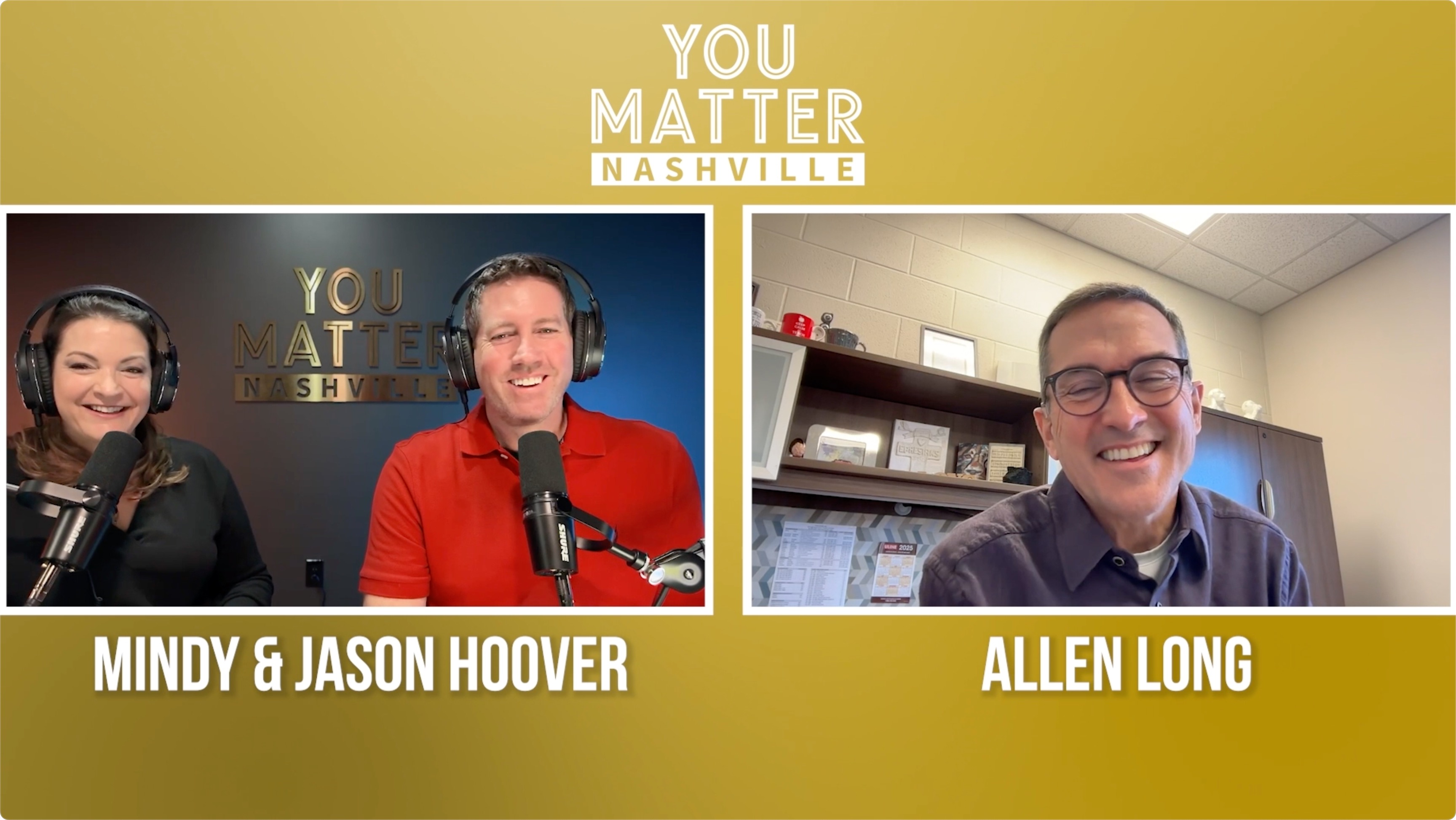
What does it take to hand someone back their independence? Sometimes it's as simple, and as hard to come by, as a white cane. On this episode of You Matter Nashville, Jason and Mindy Hoover sit down with James "Jimmy" Boehm, co-founder of You Cane Give.
Jimmy lost his own sight in 2010, and the road back led him to a mission that now reaches around the world.
Who does You Cane Give serve?
You Cane Give is a Nashville-based 501(c)(3) nonprofit that serves people who are blind or visually impaired, at home in Tennessee and in dozens of countries. At the center of the work is something most sighted people never think about: a reliable white cane.
The organization provides restored white canes along with mobility training, so a cane isn't just handed over but actually put to use. Each one comes with what the team calls a white cane first aid kit, so recipients can keep it working over time.
The people it reaches are often those with the fewest resources and the least access to mobility aids, the kind of gap that keeps a person stuck at home rather than out in their community.
Who is Jimmy Boehm, and how did he lose his sight?
Jimmy Boehm's story doesn't run in a straight line. Born in Germany and raised in West Tennessee, he spent fifteen years in the automotive styling business, the custom trim, pinstriping, and chrome work he loved for its creativity.
In 2010, during the hardest stretch of his life, Jimmy survived a suicide attempt that left him blind. He is open about that part of his story, because openness is exactly what he wants others in crisis to have.
The recovery was slow and complete. He learned to navigate with a cane and to read Braille, went back to school, and became a licensed mental health therapist who now helps other people through their own hardest seasons. His motto is the short version of everything he learned.
"Hold On, Pain Ends."
How did a blind man start giving canes to the world?
The idea for You Cane Give grew out of two things Jimmy couldn't unsee, even without his sight. The first was that a cane could be personal. He started making custom canes, because being blind doesn't erase who a person is.
"Just because you're blind doesn't mean you don't have personality or style."
The second was a conversation with a man from Nigeria who showed Jimmy his first folding white cane. It had cost about 150 dollars, which in his community was close to a month's rent for a family. In much of the world, that price means canes are rare, and mobility training is rarer still.
That gap became the mission. Nearly a decade in, You Cane Give has provided more than 3,100 canes across 48 countries as of the 2025 conversation, and it keeps growing.
What comes with a You Cane Give cane?
Over time the team turned a single cane into a whole kit. Alongside the cane and the maintenance first aid kit, recipients get a solar-powered audio player loaded with a mobility training guide and a cane restoration guide, recorded in their own language, plus testimonies from other people who have walked the same road.
You Cane Give has also added mental health services and, just as important, connections to local organizations already working in a recipient's country. Often people don't know those groups exist, so the introduction becomes its own kind of gift.
Whether the team ships canes or travels to distribute them in person, the goal is the same: not just a tool, but training, encouragement, and a network.
Why do mobility canes matter so much?
The stakes are bigger than they look. By the figures Jimmy cited from the IAPB Vision Atlas, more than two billion people live with some form of visual impairment or blindness, and a large share of it is preventable or treatable. Among blind adults, unemployment runs around 70 percent.
Without a cane and training, the cycle is brutal and predictable. A person stays home, so they're not seen, so they don't go to school or work, so the community assumes blindness means dependence, and the cycle tightens.
A cane breaks that loop. It gets someone back out the door, into a classroom, a job, a church, a life. One of the first cane recipients in Kenya, a man named Moses, had been disowned by his family after losing his sight, and the head of the African Union of the Blind told Jimmy that what he's really handing out isn't just canes, it's lives saved.
Where does You Cane Give work?
You Cane Give is based in Nashville, and its reach is global. The greatest need, Jimmy explained, is concentrated where resources are thinnest, across parts of Africa and South Asia among them. He has personally traveled to Kenya and South Africa to help distribute canes and provide training. As of the episode the nonprofit had reached 48 countries and expected to pass 50 in its tenth year.
How can you help?
There are a lot of ways in, and the nonprofit is built to use many hands. You can give a one-time gift or become a monthly donor, or donate a gently used cane.
You can also gather a small group at a church or in your town to restore donated canes at a restoration event. Beyond that, volunteers help with grant writing, social media, graphic design, outreach, and even joining mission trips to distribute canes in person. If you have a skill, there's likely a place for it.
Jimmy's throughline is hard-won and simple. He came through the worst moment of his life and decided to spend the rest of it making sure other people have the tools, and the hope, to keep going.
That's the quiet, stubborn kind of good this community is full of, and it's why his story matters far beyond the cane in someone's hand.
Episode Resources
- Official site: youcanegive.org
- Donate: youcanegive.org/donate
- About You Cane Give: youcanegive.org/about
Ways to Help
Support You Cane Give with a one-time gift or as a monthly donor, or donate a gently used cane. You can gather a small group to restore donated canes at a restoration event, or volunteer your skills, from grant writing and social media to graphic design, outreach, and even mission trips to help distribute canes in person.
Guest Information
James Boehm
James "Jimmy" Boehm is the co-founder and CEO of You Cane Give, a Nashville-based nonprofit that serves people who are blind or visually impaired. Born in Germany and raised in West Tennessee, he spent fifteen years in the automotive styling business before losing his sight in 2010. He rebuilt his life, learned to navigate with a cane and Braille, and became a licensed mental health therapist, practicing today through Alliance Counseling in the Nashville area and The Refuge Center in Franklin. His personal motto, HOPE, stands for Hold On, Pain Ends.
Visit the guest websiteAbout the Organization
You Cane Give
You Cane Give is a Nashville-based 501(c)(3) nonprofit that serves people who are blind or visually impaired. It provides restored white canes, mobility training, and solar-powered audio players loaded with a mobility guide, a cane-maintenance guide, and recorded testimonies in the recipient's language, along with mental health support and connections to local organizations. Each cane comes with a white cane first aid kit for upkeep. Founded by Jimmy and Wendy Boehm, the organization has provided more than 3,100 canes across 48 countries and works to break the cycle where blindness leads to isolation and unemployment. Its official site is youcanegive.org.
Visit the organization websiteKnow Someone Making a Difference?
Nominate a Middle Tennessee changemaker for a future You Matter Nashville episode.
Nominate a GuestYou Cane Give, youcanegive.org (official 501(c)(3) site, verified 2026-08-08). Episode interview with co-founder James "Jimmy" Boehm, You Matter Nashville, recorded 2025. Cane totals, country count, and statistics on visual impairment are as stated by the guest in the episode (citing the IAPB Vision Atlas) and may have changed; see youcanegive.org for current figures.
Full transcript
Read
speaker-0 (00:00.098)
Welcome to You Matter Nashville, where we celebrate the people and stories that make our community so special. We believe that everyone has a story to tell, and more importantly, everyone here matters. We're your hosts, Jason and Mindy Hoover, and we're passionate about shining a light on individuals who are making a real impact right here in Middle Tennessee. This is about community, connection,
and the incredible people who are making a difference. Let's dive in as we uncover powerful stories and meet remarkable people whose journeys will inspire us all, right here on You Matter Nashville.
speaker-0 (00:37.41)
Welcome back to You Matter Nashville. I am Jason Hoover alongside my beautiful wife and co-host, Mindy Hoover. And today we are honored to welcome Jimmy Bain. He is the CEO and co-founder of the nonprofit, You Can Give. Now, Jimmy's story reads like a map that only makes sense when you look back at where you've been. Born in Germany, but shaped by Tennessee, he spent years as a mental health counselor, a profession that seemed to choose him rather than the other way around.
Now, 16 years ago, vision loss arrived uninvited, but like an unexpected guest who changes everything, it brought a clarity to Jimmy never anticipated. What once felt like a limitation became a lens revealing not only his own hidden struggles, but also illuminating the paths of those he serves. That shift from darkest to insight, it sparked something deeper.
a fierce commitment to ensuring others have the tools they need to navigate their own journeys. Through You Can Give, Jimmy now offers more than mobility aids. He equips people with independence, dignity, and the tangible means to live into the fullness of who they were created to be. Jimmy, so good to have you on the show.
Thank you, so glad to be here, it's an honor.
Well, Jimmy, I would love for you to tell the audience a little bit about yourself and what you do.
speaker-1 (02:04.366)
Sure. So I am a mental health therapist. I work at my private practice called Alliance Counseling of Nashville. I also work as a therapist and the accessibility coordinator at the Refuge Center in Franklin, Tennessee. Yes. And so stay pretty busy.
I'm also married. It's 10 years as of this year with my beautiful co-host that's not here right now, Staying busy with this nonprofit that you can give and the part that goes along with it, the custom cane, which we'll talk about in a little bit, keeps us pretty busy.
I love it.
speaker-0 (03:02.498)
Yes. So just I want to let everybody understand, currently you do counseling. Yes. Now you mentioned the Refuge Center in Franklin. Is that where your office is or how does that
office there and then I'll also have an office in Brentwood. Okay. That's where my private practice Alliance counseling is.
Perfect. All right. So how long have you lived here in the middle Tennessee area?
I've been in, well, that sounded country. I've been here since 2011 in middle Tennessee. Before that I lived in West Tennessee. That's where I pretty much grew up. I was born in Germany. My dad was in the army and when he retired, we ended up in Jackson, Tennessee.
30 years.
speaker-1 (04:06.406)
And so pretty much grew up around there. And that was kind of where my first career was in the automotive industry. And then, yeah, eventually ended up here in middle Tennessee.
So you were born in Germany?
I was. Yeah. Had the, that was actually my first language, you know, English second. And so had the cute little German voice and, yeah, yeah. Yeah. But it's, it's gone. So how long
that live over there.
Lived there until was a little over seven. So was about seven and half when we moved here to the States when my dad retired from the military. All right. And that's where he met my mom, who's German and Polish. so, yeah, so they liked each other. And then I guess then I came and we moved to Jackson.
speaker-0 (04:40.439)
Okay.
speaker-0 (05:03.374)
It's a song about that, isn't it? Yeah.
It's music city. All right, so let's talk about how all of this came to be. So it kind of starts there in Jackson, right?
Yeah, I mean that.
It started in Jackson. I had started working with a friend that had an automotive restyling business and really enjoyed doing that. You know, what teenager would not.
And this was in the 90s.
speaker-1 (05:47.918)
This was, you're really telling my age. Yeah. was in the nineties. Yeah. Thanks. And so I, uh, enjoyed doing that. So by the time I was ready to graduate, since you did that 1998, uh, uh, what I wanted to do and I enjoyed doing it. And so, um, I
It's two-twenties, Jason.
speaker-1 (06:16.846)
went into the automotive business year or two after that, started my own automotive restyling business and went on my own and did that until 2010.
Okay. what was it in the auto industry that you were doing? said, I mean, it styling it out, like putting lift kits?
Oh gosh. Oh gosh. You know, it's like, you know, pimp my ride, you know, crazy like, like that. But I mean, we, you know, did some pretty neat, neat stuff, but you know, I've worked for body shops that needed something done or someone who was restoring a vehicle. Yeah. I'd be the one they would usually call, you know, everything had to be just perfect and just so whether it's a trim piece or a, a stripe or something like that.
They would usually reach out to me. Most of my work was with the dealerships in West Tennessee. So dealerships, body shops, and then also just repeat customers that would want something just to personalize their vehicle, make it look different than everyone else. I loved it.
I remember that was a very good thing. I don't know is it still a thing now?
speaker-1 (07:34.378)
It is. It's one of those things that goes in cycles. Yeah. Yeah. It gets really big. right now, Chrome accessories, Chrome trim apparently is not a big thing right now. And gosh, when I was doing it, man, I did a lot of Chrome. I lit a lot of Chrome grills, did a lot of pinstriping and graphics, sunroofs. We did the spoilers on the back.
wood grain interior, so did a lot of really neat things like that. But again, it's kind of like clothing or music, it just kind of goes in cycles. Gotcha. But it'll be back.
So how long did you do that?
So, you know, started 1995 and did that until 2010.
OK, so you did that for a pretty good while. All right, so for 15 years, that's a lot of time to put into something like this now. So it's safe to say you're very artistic. Is that right?
speaker-1 (08:33.42)
Yeah.
speaker-1 (08:46.734)
drawing, you know, stick figure, maybe. But when it came to design and, know, finding something that, that looked good or getting to know people and, taking that and the vehicle that they chose and, finding what looked good on that vehicle. Right. That was something I, I,
was really good at. yeah, you know, being creative and you know, a lot of what I did was custom and was was very unique. And so yeah, I did enjoy the creative aspect of it.
So, well, go ahead and let's talk about, you know, something happened in your life and I don't want to share. I want you to share that with the audience, but you had a life-changing moment. Can you kind of go back to that time and share a little bit of that backstory for us?
So mid-2000s, I had been married for a few years already and that relationship had taken a turn to the point to where my wife and I had separated.
was something that I was hoping that we would be able to work out, guess what was in the cards. And that was one of the hard lessons I had to learn was that you can't make anyone do anything they don't want to do, no matter how hard you want them to or how much you love them. so that was really difficult. If you think around that time,
speaker-1 (10:40.526)
2008, 2009, the economy was not doing very well. Car business just was basically at a standstill. So that was really slow. And I didn't know anything about support. I didn't know anything about counseling or therapy or
numbers or places you can go for people to help you through these difficult times. All I knew was about church and if you're having problems, then you're a bad Christian. But didn't know anything about counseling. so getting into it I can see that it was
depression and anxiety, definitely depression and grief and loss. Didn't know how to cope with it effectively. depression, tend to self isolate. Definitely did a lot of that. It was just kind of giving up in the sense of, you know, just letting the business go. My wife,
and
speaker-1 (12:05.878)
separated at that time, it got into the point where it was just ridiculous on. It just got ugly to the point that, you know, if it's all about these material things, just let it go. I don't care. And the few folks that I did hang out with every once in a while, fortunately, they introduced me to
ways of coping that aren't good coping mechanisms like drugs. so, you know, a first taste of that with cocaine was, wow, I could feel good for a little while. Like I didn't feel that pain, right? It felt nice. I could go an evening without crying, you know.
and feel like I'm burdening my friends. so, but then as things just continued to get worse and worse, you know, that every once in a while, coping mechanism became more of a daily, part of my day. And so between that and the car business slow and just kind of letting things go,
You know, it just, I went into a really, really bad place. And so in 2010, I just remember one day and this wasn't anything planned that I had thought of or wanted to do. Around that time, divorce was still ongoing. It ended up lasting six years. So just imagine the six year divorce.
my goodness.
speaker-1 (14:00.716)
Yeah, and I was blind four years of it. I mean, I was sighted four years of it. Okay. And still blind for two years still had to go through it. So I just remembered feeling like a zombie just feeling like a blur, like slow mo, slow motion. And so dealing with that work really, really, really slow. The house that I had, you this was the dream house.
and it was like a Kirkland's house. was just so beautifully done. I couldn't stay there because it just hurt. That's where I was going to start my family and have kids and so forth. so around that same time, I had allowed someone who had about four kids that were being evicted out of an apartment. told them, you just stay there till you find yourself another place. And that was another
hard lesson I had to learn is that you document everything, right? You get a contract. And I was just trying to help somebody out last minute and they would not move out. And I couldn't do anything about it because there was no contract. And they destroyed that house. so I'm dealing with that.
We just invited them to stay short term just until they get on their feet and then they decided they're not leaving.
Yeah, I all my stuff out. I moved all my stuff out real quickly and and then that way they they could move in because yeah, I just felt bad for the kids, you know And just wanted to help them out I'm not staying there anyways But you know after a few weeks, I'm like, so how's the apartment search? And I just got this feeling Something's not right. And then yeah, it just then I couldn't get him out and found out that
speaker-1 (15:57.198)
you know, that there is no, can just tell them to leave. Right. So, so I was dealing with all of that. Um, and so, you know, living out of, uh, out of visiting parent, my parents sometimes staying with them, staying with, uh, another friend that, that was a really good friend to me. Um, and, uh, you know, all my stuff in storage. So, um, it was,
Yeah, just all of that together. was just, it's just, yeah.
You had a home, but you're living with other people because they took over your own place. Right? Right. my God.
Right. Right. And just we're destroying it, you know, so it's like, if I ever do did get them out, like, there's gonna be so much work that's gonna have to be done.
So that had to play a toll along with the divorce going on.
speaker-1 (16:53.032)
All of that, you know, it was a neighborhood, you know, to get the kids, you know, in the end of a cove. And so you see that and reminds me, you know, it's like, you know, thought it'd be having a kid by now, you know, or kids, you know, so, so that was tough. And so all of that was happening at once. And being that had just moved my stuff into storage, if you've ever moved or put stuff in the storage, it's so easy to lose things, right?
Where did I put that, you know, tool or where did I put that hammer? Yeah, it's hard, especially if you move out quickly because you're trying to help somebody. long story short, I, that, that one day, like I said, everything was just a blur. Nothing was working out. Had a, not a good conversation with the X.
test.
speaker-1 (17:51.342)
had gotten information more about the house. So that was not going well. Um, and I remember a couple of jobs fell through. So I was starting to head back towards my friend's house and they're just so it was, I believe a Friday and it was starting to, it was starting to sunset, um, and get dark and there just happened to be a random roadblock. And, um, and so,
Uh, one of the things I could not find was my stinking driver's license. So I had a, a handgun permit and on the permit, you know, it has the same information, but, but it's, know, they want a driver's license, right? So, but anyway, so I, when they stopped me at the roadblock, you know, I told them what happened. And of course I told them I had, I had a gun. You're supposed to, you know, supposed to do that. And, um, so it,
He did not seem very happy that I did not have my license with me. And so I'm like, oh man. So sit there and wait and wait and wait. And then he comes and he says, did you know your license is suspended? I was like, no, why would my license be suspended? He said, well, you have an unpaid ticket in Nashville from two years ago.
And I was like, I paid that ticket. Like I remember paying for that. He said, no, he said, well, you don't have your license. Your license is suspended. and as he was saying that, I noticed the other four sheriff's officers kind of walk in their way. I was in a suburban and, and so I was like, what are they doing?
And so he said, I need you just to pull over and get out. And when he said that, that was just like the straw that broke the camel's back. So I'm like, if I get out of this vehicle, they're going to arrest me. Right. And I guess I assumed that if I didn't have my driver's license and that suspended. So I took off, hit the pedal to the metal and ended up being a
speaker-1 (20:19.406)
nine mile police chase and long story short was that I had gotten off a side road. got stuck. They had drew their weapons. They told me to get out the vehicle and I remember just begging them, you know, please just to stop. Just leave me alone. Please leave me alone. And when I tried
because I was kind of stuck in an embankment. So when I backed up a little bit and started to go back up the embankment, they started to discharge their weapons. And they basically blew out every window in my suburban that those back doors were completely shot up. They found a bullet on the air vent right to the right of the steering wheel. So I mean, and there was a bullet that went through the passenger side chair.
seats. So if I had someone with me, they would have been hit. So deescalation, right? No, what did I do? Yeah, I didn't point my gun or anything at them. You know, I just just didn't want to get hurt, you know. So anyway, I took off. And by eighth of a mile, I jumped out of the vehicle, grabbed my took my gun with me was a 45. And
And as I'm telling you this, I didn't remember any of this at all. Again, none of this was planned. Never had thought about ending my life. but I just remember running into, this field that had kind of a tree that was a large tree kind of sitting out further than the tree line. And I just remember laying on my stomach and, just thinking, guess this is it.
Like I don't know how I'm going to get out of this now. They're shooting at me. And so I was like, well, I guess this is it. So I remember laying down and then I start hearing helicopters and dogs behind me and more lights. And I'm like, yeah, once they find me, like it's over. So I was like, well, I guess this is it. So I cocked the gun.
speaker-1 (22:42.68)
pointed it on the side of my head and I pulled the trigger. When I pulled the trigger, the gun jammed. I was like, crap. So I can't even do this. And so I was looking and seeing what happened and when trying to see why the gun had jammed up, it fired, discharged. So when that happened, of course, everybody got quiet.
Right. And then I'm like, oh crap. Now they think I'm shooting at shooting at them. Right. So I re chamber the bullet and, um, and very quickly pointed and shot. And that time the bullet went through, um, and it went through here where you can just see a space light indention and then came out, uh, where my, my eyebrow is here on the left side. Um, but I call that that's.
the shot that saved my life because if that first bullet would not have gotten, or it got stuck, mean, it would have, I had it positioned, it would have gone, the trajectory would have been a lot different. But being that I was out of panic and being afraid, no, now they're thinking I'm shooting at them.
felt that was the bullet that saved my life. And so I was airlifted. They found me. was airlifted to Memphis. had about 20 % chance of survival initially. There were several surgeries. So I woke up. I was in the ICU, woke up, didn't know where I was at, had no recollection of what was going on.
Why can't I see why do I have a breathing tube down my throat so I can't talk? Why are my arms restrained in my legs so I can't move? And that's the point that was rock bottom. And that was the point where like, um, couldn't see, couldn't remember anything. I couldn't move. Um, and I couldn't talk. Right. Um, and so
speaker-1 (25:12.302)
But around that time then I heard a voice and I could hear my dad's voice, I guess, get my mom's attention and they came and it's like, thank goodness there's someone here that, I guess, whatever it is, they're here. They're here. And so, you know, can't communicate with them because I got the breathing tube down my throat and, you know, they're
So were you in a coma?
yeah, I mean, I was out and I don't, I, you know, I, I'm assuming it was also maybe induced also because of this, the surgeries once they knew I was going to survive and make it.
So how long were you in the hospital?
Long all together it was I think almost three weeks So I I finally got I've made a gesture with my my hand like I wanted to write something because I couldn't say anything and couldn't see so my dad brought a Pen and paper and I wrote down where am I what happened?
speaker-1 (26:25.29)
My dad kept that paper, right? Cause I had no, and so that's when he kind of told me a little bit and, you know, it started to a little bit at a time start to come back. And so those, then those few days were just devastating, right? Cause I'm thinking, I'm thinking, no, I'm blind now.
I don't know what that means. Does this mean nursing home, rest of my life? Then it's, my gosh, what I put my family through, then it's, my gosh.
Am I going to prison? After all of that, so the legal ramifications, plus I'm still going through a divorce, plus still the house. all of that stuff was just, yeah. So all of that was still there, you know? And, so that was, that was really tough. and I remember it was about the third day after I had been awake. I remember my dad coming in and,
Yeah, that's a real thought.
speaker-1 (27:37.058)
I said, dad, I just kind of had a realization. He goes, what's that? I said, well, I can either be a bump on the log the rest of my life and have people take care of me or I can take this head on. Yeah. I said, can you hand me the phone? So he handed me the phone and a first time dialing out blind. took me a couple of times to dial the number, but I called my sister. and so she was not expecting a call from me.
She lives in Memphis and that's where I was at and my parents lived there too. And I told her, said, Hey, Marie, can you, can you Google the braille alphabet? Cause I guess I'm going to have to learn this stuff. And so can you see how it works? And so she read it and described it to me. And so after those few weeks, after I left the hospital, I knew through the letter K, I hadn't felt it yet.
But I had it memorized, and I understood how the dots worked, learned. And then there was a couple other surgeries I had to have. So basically, the whole right side of my face was facially reconstructed. So, know, fridge magnets, great party. Now I'm joking.
Um, but I did, I did lose my, my, my left eye. The, was damaged really badly. Um, so they had to remove it. So that was another surgery. And then my other eye, um, the bullet, cause again, this is a 45 caliber. Um, and, uh, it, um, severed the optic nerve. I was very fortunate for a 45 caliber.
lost my vision. I did lose my sense of taste and smell. You lost three senses. Yeah. But I had no brain damage. I guess you could certain people may disagree. No brain damage. And you know, I've met people who have had had trauma or injuries and they've had, you know, seizures and strokes or
speaker-1 (30:04.276)
lose ability on a limb or their hands and I had none of that. But anyway, so.
bit of blessing in that.
Yeah, yeah, yeah, it could have been a lot worse.
So you, uh, you get out of the hospital and you decide that you're going to take life head on, uh, which, know, what you, you were going through, um, you know, everybody has battles and, know, we, and some are, you know, are so deep that people just don't even understand what's going through. And it's just like, you know,
you never in your life would have thought you would run from the cops like that, much less pull out a gun. you know, things happen in in moments like this, but when it's, um, when it's heightened by, you you're losing your job. mean, your, your livelihood seems to be going away. Your marriage seems to be going away. Um, you had the drugs that are happening that's going to affect you. So,
speaker-1 (30:56.001)
No.
speaker-0 (31:20.364)
I mean, you had all of this happening at one time.
Right.
And this goes back to, sometimes good people make bad decisions. And case in point, you know, really good guy. Just life happened. Literally just major, you know, fight or flight moment. Your brain just got to its point that it couldn't cope. your body and your mind does some really strange things. We all know this. It's unfortunate, but the great thing is,
the choices you make afterwards. Like you said, you wanted to take, tackle everything head on. wanted to, you didn't want to be a lump on a log. You wanted to be a productive person and, kind of hit it all head on. I would love to hear about, you know, your next steps, how you started progressing and what spurred your love for what you do now, how that kind of snowballed.
Yeah, yeah. Thank you. And I think just one thing I do want to say was, is that in my journey, one of the things that sometimes I hear people say is, and we do, you look for signs, maybe people are giving away belongings, maybe they're writing goodbye letters, or, you know, they're saying goodbye to people, you know, those are definitely signs where they get a weapon, right?
speaker-1 (32:47.448)
But that's not always the case. People don't always plan for it. It could be like in my situation, just something that you have all these things hitting at once. that it just, they just snap. And like you said, when that happens, you're not thinking rationally. There is no thinking, how's this going to affect my family or how's this going to affect
my friends or, you know, is, is it a sin or, know, or, or what have you, you don't think you're not able to, you're not thinking clearly, you're not thinking rationally. And so we have to keep that in mind that there's not always a plan and there's not, well, there is no rationalization. There is no clear thinking there. Cause like you said, you're so far out of your window of tolerance, the five flight freeze mode.
or so deep down in that depression, that part of our brain just shuts down. And then self-medicating, that doesn't help either. And so I had no idea what next steps were. First, I had to deal with the legal stuff. I knew that that was gonna be tough.
and so there were charges, felony charges against me for evading arrest. I guess, well, because I took off that I, I put the officer's life in danger. So that was five counts of aggravated assault, cancer officer, resisting arrest, speed ticket, going 85 in the mile speed zone is all those things. And so I was looking at.
30 to 35 years in prison. How am I going to be a blind guy in prison? see the things about the stories, you know, my little skinny white butt in jail as a blind guy. my gosh, right. It scared me to death, right. But, you know, thank goodness my dad spoke with the investigator with the TBI that
speaker-1 (35:12.588)
that happened to be there that night and kind of shared with him what I had been through and they talked to the judge. I was very fortunate to be able to, after six months of having to go back to court, go back to court for hearings and all that stuff, got five years probation and
know, if I behaved for five years, it was, we call it exhumed.
That's onrated.
dishonor. Yeah. So, it's, it never, it's not on my record or anything. So that was a blessing, but you know, just, that was so stressful in itself. but the other thing that I learned that was important was that, before I was going to learn to do anything, what I'm going to do next is I had to get my mental health back on track before I tried to learn.
how to be blind and learn how to use a cane or Braille or a computer. I had to get my brain health better. so obviously that was something that was, know, a direction that was given to me and to my family that needed to be assessed. And so I did after
speaker-1 (36:43.63)
I guess about another two months of just recovery at home, my parents, which could not have done it without them. And my sister and brother-in-law, they really were there for me. That was another hard lesson I learned was there were a lot of people that I thought that would be there that weren't right. So that learned who your friends are and who aren't. So, so that, sucked, but
Anyways, they were there for me and so I did intensive outpatient, did groups and then eventually transitioned to one-on-one individual therapy, which was helpful. Around that time then we had found out about a center in Smyrna that had a blind services where they
would teach you braille and they teach you how to use your cane and technology and independent skills and help you find a job. And so once I had my brain health where it needed to be, we're at a good enough place, then it's seeked out an opportunity to go there. And so that's what brought me to middle Tennessee mid 2011.
OK, that's how you ended up here.
Yeah. And I really, I didn't want to wait. you know, I told my dad, said, well, I guess somebody need a cane too. Can you, you know, give me one? And he's like, sure. Well, let's look online. I'm like, well, kind of they got, you know, here's Mr. my ride. He's like, well, they have a white cane or a white cane with a red tip. And I'm like, that's it. He was like, yeah. It's like, so I got a cane and
speaker-1 (38:45.678)
I used the vinyl materials and stuff that I used on cards and stuff and made a solid black cane with a Fleur Delay emblem at the top below the handle. so that was kind of cool. And so I go to Smyrna and I'm getting this training and also just trying to figure out
what am I going to do next? yeah. The other piece was I was starting to do mobility training and learning Braille in Memphis because I just, I didn't, I wanted to get started. And so I had a good head start when it came to the navigating with my cane and with reading with Braille. So I got more of that when I moved to, when I went to Smyrna to this place and
They do these career assessments and they ask you, you try out these different things like, maybe what about in the factory? Put these bolts together, let's time you. I don't want to do that all day long, that's boring. I want to be around people, I to talk to people. Then they're like, well, there's this vending program. You could probably talk to people, but you're filling up snack machines and I don't want to.
fill up a Coke machine. That's not really what I find some creativity. You know, I'm going to do design how I'm going to put the colors of the drinks in there. So it looks prettier, you know, so that that wasn't anything that was of interest to me. but then I thought about this one guy that when I was doing the intensive outpatient, I had shared some of my story.
which still took a while for me to remember everything. And there's still times when I speak about this, that I'll remember something new, which is kind of interesting how our brain works. But I remember that he, this guy came to me and he said, he said, Jimmy, I heard your story. And he said, you know, I've gotten really close three times to ending my life. And he said, but after hearing your story, I,
speaker-1 (41:14.894)
have a new appreciation for life. And I just want to say thank you. And I was like, you're welcome. You're welcome. I know what I did, you but I remembered that. And so I remember asking, like, is there a place? Does that require college? And so they're like, yeah, that you have to go to college and like,
Do blind people go to college? Yeah, there's lots of blind people that go to college. And MTSU has a disability services program that's actually the director, he's blind. there's psychology there or that could possibly be something that you could do. so, I remember it's clear as day when I graduated.
1998 that I'm done with school, never going back to school. so I those words. Yeah, in high school when I graduated 98 and graduated, know, I ate those words. I'm not going back to school.
College is different.
It is. you know, I think going there later in life, it was a totally different experience also, and I appreciated it. Yes. took it more seriously.
speaker-0 (42:41.113)
definitely. Can understand.
Yeah. So, so I went to MTSU for four and a half years. And that was around the time I met my wife, Wendy met her funny stories. She, they had asked me to be on a job hiring committee and narrowed down these 25 applicants to five. And so I was doing that. was reading it with my computer.
retail out to me and say, Ooh, this person's interesting. So if you're ever wanting to date somebody and you want to know everything about them, just find some job hiring committees that you can be a part of because you get all of their history and so forth. But that she was one of my five that I had chosen and she got the job. And so that's when I met her. She worked at MTSU for about a year or so.
but then moved on to something that it was more of what she wanted to do, which is work with the kids in this job was more of like admin kind of stuff. But yeah, I was finishing up school and then around that time, she and I reconnected and started dating and so forth. So by the time I graduated,
Again, it's not something at all that I had planned or was on my mind at all, but it just kind of happened. And so we got married and then of course, be a counselor, bachelor's degree is not enough. And so that I had to go and I wanted to...
speaker-1 (44:36.354)
Since my wife was in Nashville, I wanted to find a university in Nashville that I could go. so I applied to Peabody College of Vanderbilt. And Wendy was like, well, you need to apply to other schools too. I'm like, no, I'm going to Peabody. This is where I'm going. She's like, okay, it's very competitive. So I got in, thank goodness. But so that was really cool.
But in that journey of college, I was looking at things from the standpoint of, like in psychology and stuff, as people with disabilities. And I got involved with a lot of advocacy in different organizations that did advocacy on a local, state, and national level. And just learned a lot about some of the ableism that
that's out there, the discrimination, the negative assumptions people make about you. They can't see past your disability. Yeah, they assume you can do something. I still deal with that today. I'm a Peabody graduate of Vanderbilt. I've done so much and I still at times have to deal with
people that I work under questioning my abilities, which is struggle.
Yeah, I I can't imagine, but that happens with so many people, you that you get labeled or they can't see past the one defining thing that is about you, but it's not you. A lot of people go through that. That's not me. That's not my spirit. That's my soul.
speaker-1 (46:30.732)
Yes. So you got, when you go through, I was going to say, and so when you go through that, you know, and, me being someone who was an advocate and who, you know, started to advocate and got involved and started a guide dog nonprofit organization, cause there was a need for support, for, you know, vets was service animals that were dealing with discrimination and, find people with guide dogs. And I got to,
I'm sorry, go ahead.
speaker-1 (47:00.672)
a guide dog. Second year I was in college. so, you know, I, yeah, just saw, you know, the challenges there. And there's a lot of times you have to advocate or you just you're trying to help people see things from a different perspective. And they either don't understand or they choose not to.
And when you, you're trying to reason with them a lot of times they'll, you know, this is where ableism comes in, where they, they, say, well, you're being pushy, right? And it's, it's, I'm not being, not trying to be pushy. I'm advocating, I'm trying to help you understand, know, if you experienced that discrimination being left, on the side of the road because of a, a new driver didn't want to
take my guide dog and I to the vet because something was wrong with him, which happened to me. I'm not going to be disrespectful and mean. You can advocate and still be respectful, but
Thank you.
speaker-0 (48:17.486)
Yeah, you change the ground sometimes. mean, that's yeah.
Yeah. But then they view it as, as pushy or that, that you're, you're being unprofessional. And so, you know, I deal with, with that sometimes too, but you know, what I always say is let, let my actions show who I am. And what you can give the things that we've been able to accomplish shows. if I was pushy, if I was unprofessional, if I couldn't communicate, if
if I wasn't the person that had ability, we wouldn't be in 48 countries, helped over 3,000 people, and have partners all around the world if that was that. I just say, let that speak for itself.
Yeah, before we get too far on that, let's if you don't mind, share just an overview of you can give what it is that you do or what that organization does.
Yeah. And so just really quickly. So, you know, I told you I did my first cane and when I went to that training center, people are like, wow, I want a Tennessee Vols cane, you know, with the white and orange checkers. I was like, yeah, I can do that. And one guy was like, I got a record studio. I want my, my name on, on, on my cane with the, with the, the, keys, keys on my do it.
speaker-0 (49:46.262)
Music.
You done turned country again. See, I'm country all the time.
I'm telling you.
Are you way outstayed when I'm a two? But so, so that's kind of how custom came started, because I could I could be creative. And this was something that no one thought of that just because you're blind doesn't mean you don't have personality or style, you know, and not everyone that's blind has been blind their whole life. And so that was really cool, too. And so as I was doing that, and studying
in my psychology and mental health services program, learned that there's a lot of, places where the majority of blind people around the world are your top three areas are, India has the highest population filed by China. And then, and then throughout the continent of Africa is your highest areas of.
speaker-1 (50:56.174)
people who are blind and these are places with limited resources. And also because of that, then canes have to be imported and they're very expensive. And so I met a gentleman in that was from Nigeria and he had a folding white cane and he said, you know, in Nigeria, this came about $150 us dollars. And he said, so this is my first cane. I said,
Like, what is that? Like, how, what does that match to like, and he said, it's about a month's worth of rent for a family. And so that there's not going to be a lot of, yeah. So there's not going to be a lot of canes there. There's not going to be a lot of people that provide mobility training, right? Cause there's not anyone with canes, right? And so,
And here, as I was selling canes and customizing them, people would say, you know, I want to spring cane. I want to balls cane. I want to a cane for when I go out to go dancing. Right. And so we had people had all these extra canes that they would either throw away or end up in their closet or attic. And so Wendy and I had this idea.
let's see if people will give us their old canes or maybe we'll give them a credit, a discount towards a new cane and we'll take it. We'll fix it, restore it. and yeah. And you know, let's, let's start reaching out and trying to connect with organizations out there and build relationships and partnerships and get, and so we can get canes into these, these people's hands. And so,
That's kind of how it all started. And next year, we're hitting 10 years. And like I said, we're at a little over 3100 canes now 48 countries. I'm pretty sure we'll hit 50 countries on a 10th year. And the other thing that that we came up with a few years ago around COVID was that
speaker-1 (53:16.958)
an organization makes these solar powered players that speak so that they're an audio and they have the Bible on there and they can put any language on there that that's spoken, which is really cool. And so my idea was, well, most of those people have never even seen technology like that, but what if we could get people those, but also because there's probably not any.
mobility instructors to teach them how to use their cane. Let's, let's add that to it. We put it in audio in their language. And then how about testimonies of other people and sharing their story. Right. and so we added all that to there. So it's like this all in one kit. When we give a cane to someone, they get the cane, they get extra materials called the white cane first aid kit so they can maintain it.
a friend from Kenya, came up with that name. then the solar power player, it teaches them how to use the cane as the Bible, if that's something that is important to them, their faith, but also the testimonies, hearing that they're not alone, that there are other people that have been through some tough situations, but have found a way to...
do incredible things. And so it's like this whole all-in-one kit. so that's how it's kind of taken off. it's just the experiences and the things that we've heard and seen is just so incredible.
That's great. Yeah. I love that you just, and your wife had an idea and you didn't have, you didn't think that it was going to be in all of these countries and
speaker-1 (55:10.378)
No. here I never. Yeah. And even when I could see, I never thought I would go to Africa. I've been to Africa twice. I've been to Kenya and in South Africa. Okay. And distributing, you know, go meet up with a team and go on a mission to give out canes, provide training. We now also provide suite of services like mental health services.
professional development, a of these schools, these teachers have very, very basic training, education on to be a teacher. There is no training on how to work with a student with a disability. And so that's where my wife who's now a special ed teacher, she's been doing that for 17 years.
where she's been able to provide the resources and help them be able to connect and work with children with special needs. In my background now in counseling, being able to provide that at schools that we've worked at or communities and just basically with our suite of services, finding out what they need.
And whether it is us just shipping the canes to them or us sending a team there that helps distribute them, provide training, provide mental health services, and also getting them to connect it to other organizations. Because a lot of times people don't know about other organizations that may be in their country or come to their country. And so we get them connected and they
become partners of ours and of the people that we serve. And so it's all about connecting people and, um, you know, it's just, it's just been incredible. And it's breaking that cycle of, uh, kind of what we talked about earlier is so if someone has a disability, they're blind, um, you just think about this cycle. And so then they don't have a cane, they don't have the materials, right? And so.
speaker-1 (57:31.988)
then they either stay home so they're never out in the public. So the public doesn't see them. So they don't go to school. They don't go to college. They don't have a job. They don't have a family. And so they're not seen. They're not part of the community or contributing to the community. So then you have then the community assume then that, well, blind people are financial burden.
or blind people can't do anything. And so, and then that leads, that cycle just continues, right? So what we're doing is we're breaking that cycle. We're giving them the tools, we're getting them out in the public so that they can go to church, they can go to school, they can start a family, right? And it's just been, again, just hearing the stories of, of,
of people, one gentleman, his name's Moses, a good friend of mine, one of the first cane recipients in Kenya. He went from being at a point in his life, he had just lost his vision. He was attacked on New Year's day and was hit with a beer glass or beer bottle on his face and he went blind. His family disowned him. They said, we don't know how to take care of you.
and your financial burden. So we're going to take you out into the, outskirts of town and drop you off. Yes. And so he pretty much it's like life's over. don't have anything to live for. And so he, I guess, well, a friend brought him to where we were that particular day. And I There was just something I'm like, I want to work with this guy, Moses. So he and I worked together.
and he got the player and everything. Long story short, today he is a advisor.
speaker-1 (59:39.224)
consultant to the advisor to the president of Kenya. So he works under this commissioner advisor of the president. And so and now he's part of our organization that he's he's our African ambassador because he has the connections throughout Africa. So we can get chains in and so forth. But here's a guy that his life was over. He fell.
Wow.
speaker-1 (01:00:09.388)
you know, everyone's rejected him, family abandoned him. And now he's like, working under the president traveling all over and like, you know, his, his story is just one of so many that that's what it's all about. Right. And it just, it gives me hope and just joy that, you know, there's a reason why
I, you this is the second chance of life that I have, you know, is able to make a difference. And with some of the poor decisions I made, like you said earlier, hopefully I can help people to have the resources and the tools that I didn't have. yeah, and so that way they too can get
Yeah.
speaker-1 (01:01:05.848)
the help and the resources that they need and avoid some of the mistakes that I made.
You know, I was, I did some, a little research and a couple of things stood out to me because going back to, what you're saying about, discrimination against those side impairments. I don't know if we talk about it enough or, or know enough about it, because, one of the stats, this is off of the, world health organization at least. Okay. So there's what roughly 8 billion people in the world.
At least 2.2 billion people worldwide have some form of visual impairment or blindness. 2.2 billion people. But this is what really also, it was more of a shock to me. This was IAPV Vision Atlas. A large portion of the vision loss is preventable or treatable.
Highlighting the importance of early care, rehabilitation and access to resources. So, I never knew that until, you know, I knew we were doing this and decided to look it up. And I was like, I was blown away. I didn't realize that it was that far reaching.
thinking about that, people are also starting to live longer. Yeah. And so as people are starting to live longer, that means you're going to have more people with different types of disabilities. Right. And so I think in Tennessee, it's about 20 to 25 % of people have some type of
speaker-1 (01:03:00.13)
disability seen or unseen, is, know, get all the comps, all different types of disabilities, right? And so that's going to continue. Those numbers are going to continue to go up. And so I think it's an important topic to talk about because with that, you know, helping learning how to support people.
You're talking about all in common. Yeah.
speaker-1 (01:03:29.824)
with these different disabilities is going to be going to be needed for sure. And just the people educating themselves on the abilities of people with disabilities, because they may be one of them in the future if they're living longer. of the outstanding statistics is that 70 %
70 % of blind individuals are unemployed.
Wow, really.
70 % right.
That's way too hard.
speaker-1 (01:04:12.078)
And so, you know, makes you think, you know, why is that? And it just shows that, again, some of that in the states, so I mean, some of that obviously can be, you know, resources or lack of training. But, you know, to me, it also shows that there's still some stigma there that the education that needs to be done. sure.
So I definitely want to share that you have a site that our listeners can go to.
Actually I have no site. you meant the website. bad. Sorry.
Oh, Oh, I was like, what? Oh, good one. Good one. I'm I love it. love dad jokes. Yeah. I mean, the website is a dad joke itself. Wait, you can give, but I it. Uh, but yes. So it's you cane, C A N E give.org. Y O U C A N E G I V E.org. And, um, so
You can find out a lot of the information here that we've spoken about and also some testimonials as well. Is there a way, I see here, so people can volunteer. So what are the different ways that people can support, you can give?
speaker-1 (01:05:44.48)
Yeah. And we put a spot there, a place on the website where people can see how they can get involved. Some have become part of our board maybe because they have expertise, maybe fundraising or in business or social media, things like that. so
it takes a lot to make a successful nonprofit and takes a lot of hands. And so the more hands you have with people with different experience and different parts, different facets can be really helpful. So we have people that, that help us connect with other partners, people that help with social media. Some folks are interested in going on some of these, these trips.
Right. And so we have folks that help us with restoring these canes and in their towns and cities or churches, they'll get small groups together and we'll train on how to do these restoration events. People can get involved that way. Folks who are visually impaired or know someone who's visually impaired, they can donate their
their old canes send it to us. There's a free label that they can download that they can ship it to us free of charge. yeah, no excuse. Right. And, you know, and then of course, obviously, with most businesses, it costs money to be able to travel to these places or to ship these materials or goods to these places. And the
Yeah. No, excuse.
speaker-1 (01:07:40.044)
the players, you know, none of that is cheap. so on our website, you're able to go to the donations page. And there's a way that you can give a one time donation. You can become a monthly donor. We have we have a few different like categories of of monthly donors that they get some extra benefits from from
you know, contributing monthly. And so, you know, that helps a lot as well, because that goes to helping with the trips and us buying more canes if we don't have enough to go to a certain place that as far as inventory and so forth.
Yeah, it's got a lot of information on here. So to our listeners, if you are interested, definitely check out the website. There is a volunteer page and a donate page, but there's many different ways to help. And you've got some listed here, even grant writing. I know that's a big thing. But mission trips help promote and outreach graphic designs.
So even serve on the board. there's a lot of ways, obviously monetary contributions and canes and things of that nature, but there's other ways to help as well.
Absolutely. we've had some, you know, like kids or teens do it as a part of their community service. You know, if you just wanting to do something that, you sometimes you might feel like, don't know what I could do to, that would help someone, you know, we'll put you to work.
speaker-1 (01:09:35.758)
Spend an afternoon with us. We'll sort through some canes or do some searching online to find some potential other folks to contact and try to build partnerships. On that main page, there's also the ticker so you can keep up with how many canes and countries and players have gone out. You can sign up for the newsletter.
You can sign up for the newsletter, which we are constantly updating with these stories and testimonies, pictures and videos and so forth. And on our website, it'll take you also to our social media platforms and our YouTube channel, which has a lot of videos of the actual people that and kids that have received these canes and
It's just awesome to be able to see, especially if you've made a donation or contributed to one of the events, to see that this cane went to this country.
Yeah, I love it. love, you you see the results of what you're doing to help out. Before we wrap up, also, since you do counseling, it's just, do you mind sharing what type of counseling, if anybody's interested and if they are, how they can reach you?
Absolutely. Yeah. So the website is AllianceNashville.com. I work with all different types of individual teens and up. I work with couples. I do couples counseling, pre-marital counseling. I work with individuals with disabilities, like people on the spectrum or ADHD or other disabilities.
speaker-1 (01:11:41.934)
depression, anxiety, trauma, dealing with grief and loss. Those are really big things. Then two other specialties that I
can do as well is something called EMDR, which is eye movement, desensitization, and reprocessing. that is, you may have seen people following that light that's going back and forth, or they're tapping their legs back and forth. Incredible things that I've seen in helping people.
learning to regulate themselves or being able to work through trauma and totally changes their lives. And I'm also certified in animal cycle therapy. so at certain times, you know, may find an opportunity to incorporate my, my guide dog, Dennis, who's a German shepherd sometimes incorporate him in
speaker-1 (01:12:55.24)
mindfulness practice or in some type of intervention, or have had clients use their own pets or animals, you know, and that can be really powerful as well. So yeah, AllianceNashville.com and reach out to me and we'll do what we can to help you walk on that journey and not having to do so alone. I love it.
I do too. And Jimmy, what an amazing human being you are. to know what you've gone through and you made a decision that you aren't going to be victim of your choices in the moment. you're overcoming different limitations, not just visual, but different limitations all the time.
The proof is right here that you may, you your life made a turn, but because of that, you are now reaching so many people that you'll never meet and you are impacting their lives in such a positive way. Giving them a life. Yeah, giving them a life and saving lives.
Saving lives. I was speaking with the head of the African Union of the blind and he told me JMo, which is James or Jimmy and Swahili. said, you're not just giving canes, you're saving lives. I'm like, well, what do you mean? He said, I get reports all the time of people or families trying to cross the street, even though they're blind or visually impaired.
they don't have a cane. And people who are driving, there's nothing to identify that they're visually impaired. so he said, I get stories all the time of people getting hurt or even killed because they don't have a cane. he said, you're even saving lives. And so that was another piece that was just really moving is that, you know, we have no idea how many lives we may have saved.
speaker-1 (01:15:20.035)
Also in this journey.
I agree. Absolutely. Jimmy, and just so that people know, you're also called James. So you go by James and Jimmy. if anybody's listening, that's why it's two different names. But thank you so much. I'm honored to have met you. I appreciate you sharing your story with everybody and us.
Thank
speaker-0 (01:15:51.144)
I love your heart. I love what you're doing and you're making the most of the life that you have and you're living proof of what we can all do if we just put our hearts in the right place. We can help each other. We can solve a lot of things if we live with the heart. But thank you so much. Thank you for taking time to come on here and share with everybody.
Thank you. just really honored and thank you for allowing me to share my story and meet you guys as well. And hopefully it'll give someone hope or maybe an opportunity to give back even if it's with us or in some other way, right? Just giving someone hope. And that's why I tell people.
that hope stands for hold on pain ends, right? Hold on pain. When I was at rock bottom, you know, there were, didn't have hope. I didn't see that things would ever get better, but you know, to be able to, through helping others and, and going through these difficult things, just knowing.
that there is hope, that what we're experiencing is temporary and it'll get better.
very well said. Well thank you James and Jimmy. Thank you very much and I appreciate it and I look forward to maybe meeting you in person one day.
speaker-1 (01:17:31.117)
much.
speaker-1 (01:17:37.012)
Absolutely. Thank you so much.
And to all of our listeners, thank you so much for tuning in and until next time, always do please remember that you matter. Thank you for joining us on this episode of You Matter Nashville. We hope you found inspiration on this episode and are reminded that no matter where you are or what you do, you matter. If you enjoyed this episode, please be sure to subscribe, leave us a review and even share it with your friends and family.
Also, stay connected with us on social media and tune in next time for more incredible stories from the heart of our community. Until then, remember, your story matters, your voice matters, and most of all, you matter.